Threshold work
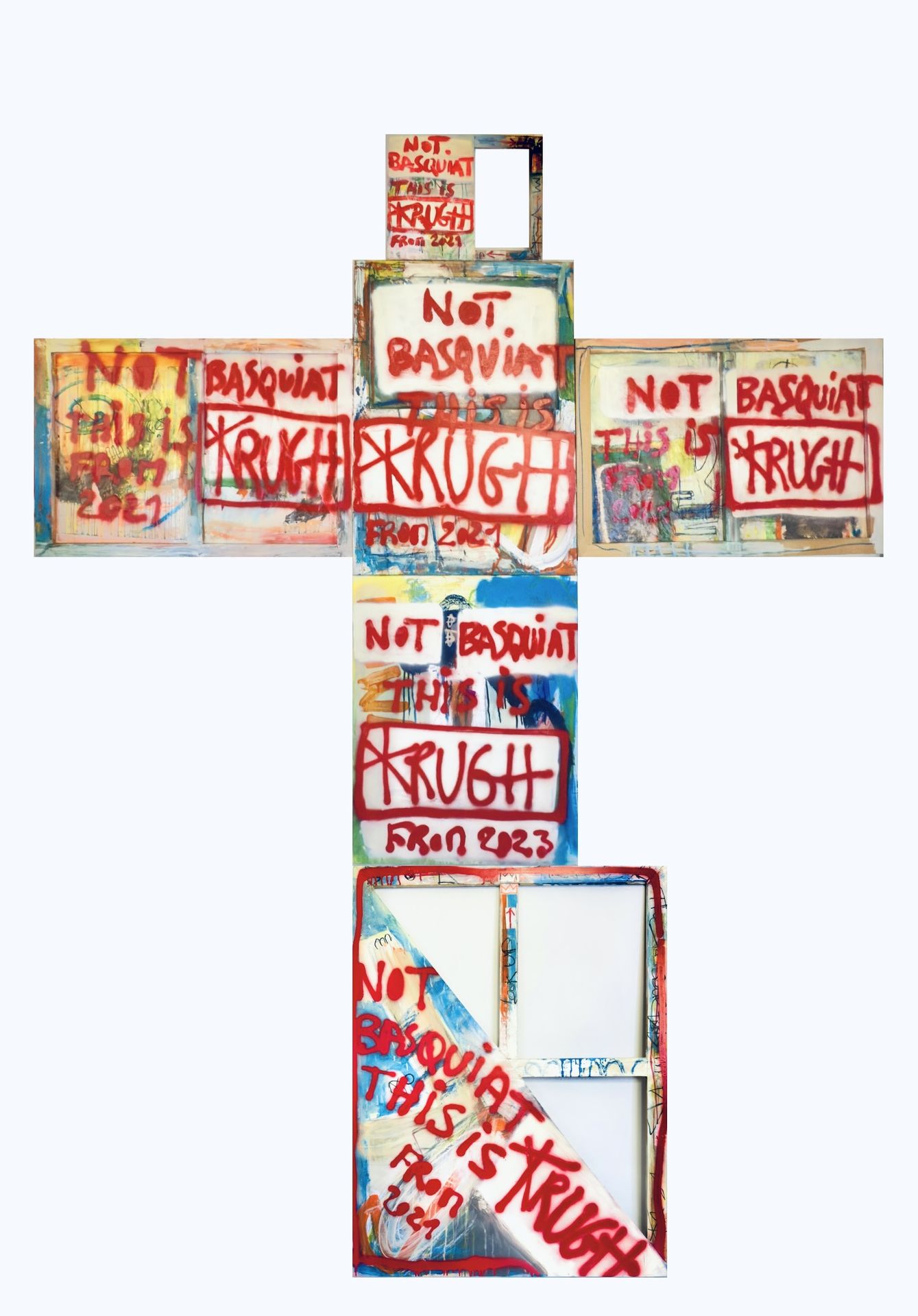
Krugh's Cross
328x249x6
This cross, over three meters high, is made from fragments of old paintings, reclaimed and assembled.
Each panel carries a part of the artist's journey :
• At the bottom : Sail - breath, the sail, the initial impulse.
• Above : The women in the distance - the trial of connection, the distance.
• On the right : Discussion — fracture, tension.
• On the left : Contemplation — a figure facing the spiral of light
• At the center ; The skylight - a crouched figure, head bowed, in inhabited silence.
• At the top : The Throne - a christ-like figure, the ultimate presence.
This is not just a construction : it is a lived cross. It tells of rupture, tension, the call of vocation and the journey through wound. It shows how the former artist is crucified so that the new, transfigured artist can be born.
The inscribed words - Not Basquiat. This Krugh- are a statement against labels, against the ease of a gaze that copies reduces. Here, it is not about following appearance or the market but about embracing a singular identity against the current.
Desecrating his own paintings, covering them, nailing them to a cross, is already an act of freedom. It is a sign of emancipation, the mark of a birth.
LIVING
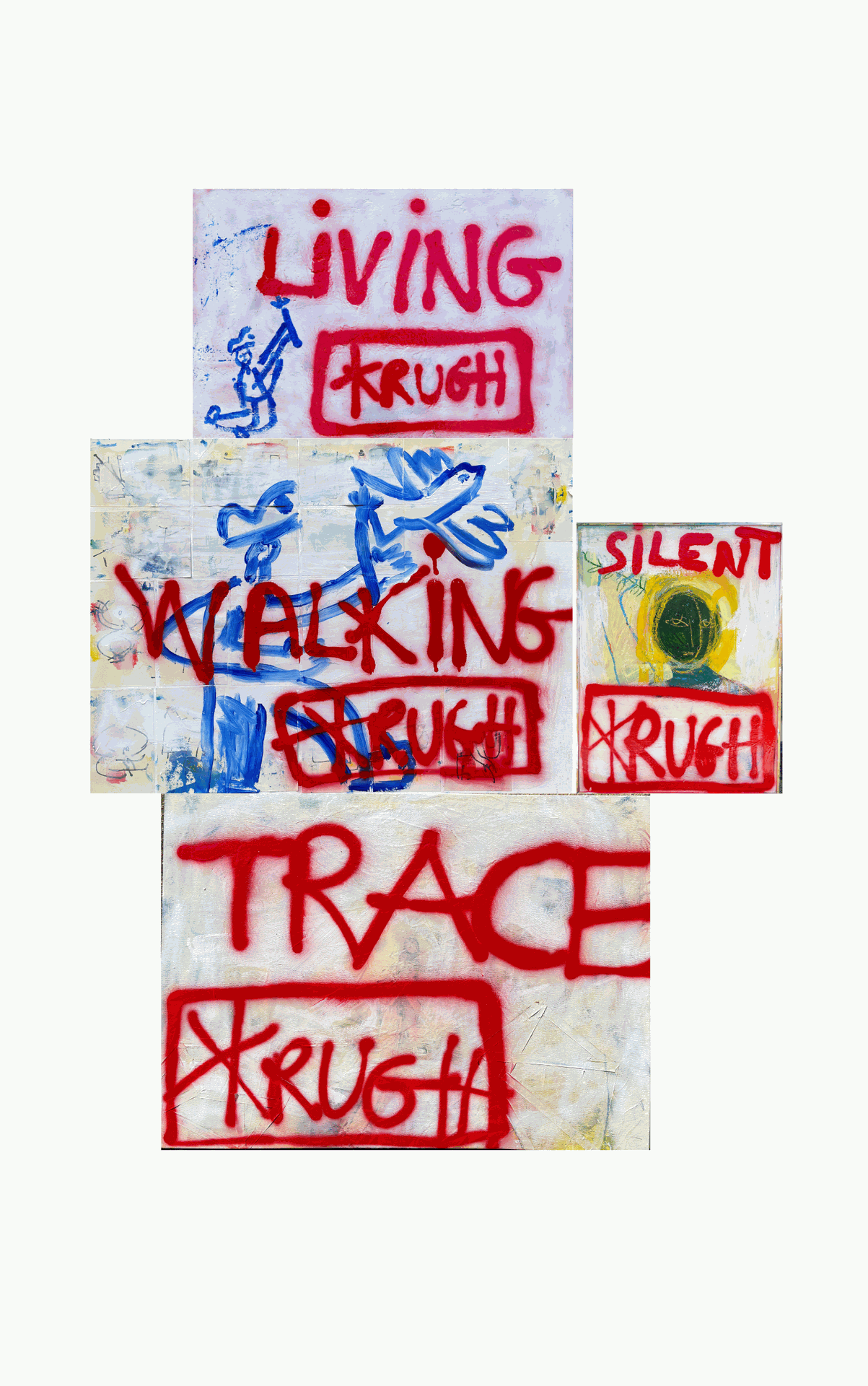
201x147x6
This cross was born from fragments.
Paintings covered, reclaimed, traverses ; traces remain visible scars. Each panel carries the memory of a passage.
TRACE : The intuitive, sensory imprint, the beginning of a gesture of weightlessness. What remains inscribed in the material as memory.
WALKING : The man with the dove head dress, a figure born from the artist, walks within the breath. The brush passes through his hand : he follows the dove or draws it.
SILENT : The experience of inhabited silence, an inner presence amid turmoil
LIVING : a proclamation of breath, at the top of the cross, and affirmation of life.
Together, thse fragments form a structure of passage : from trace to walk, from silence to life. This is not merely a collection of canvases but inner icon, a thresholds.
Pop Corn and Prayers
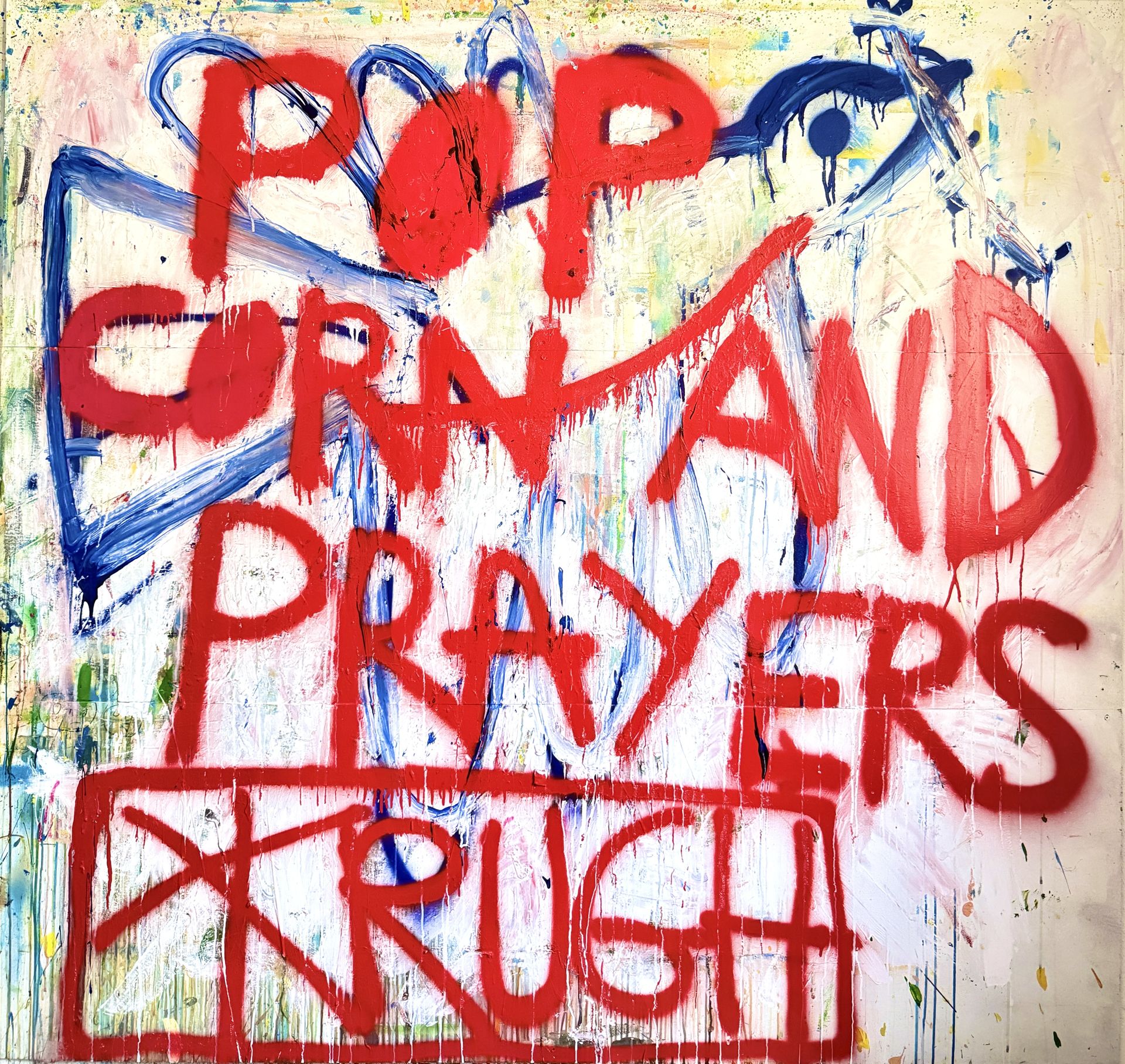
190x180x3
Red, scattered across the canvas, creates a tension between two worlds.
POP CORN : a symbol of entertainment, of consumed lightness, but also of the mask that covers, hiding the inner hunger.
PRAYERS : The call, the breath, the depth of soul and heart.
Between the two emerges a wounded "D" : the letter itself becomes a sign. As if the connection were broken, as if the alphabet carried a wound within it. This typographical fracture is no accident but a revelation : it shows that the passage from distraction to inner impulse is a torn journey.
The blue eye watches over the scene : a silent witness to a world that puts on makeup to shine, uet resists truth and the ultimate search.
The painting this becomes a battlefield : a mask of popcorn against the naked truth of breath.
A red cry, both raw and inhabited, where art becomes a passage.
This painting emerged from a three-part wooden panel used from the beginning as a support. It retains the layers of paint accumulated over time, a living memory ot the canvases that preceded it. It thus becomes bot fulfillment and witness to a manifest work. One can perceive the raw energy, the traces of gesture, an entire path inscribed in the material. In a corner, a drawing by his son, left intentionally, reminds us that the artist's story is also written in the simple, unexpected moments.
The crossing
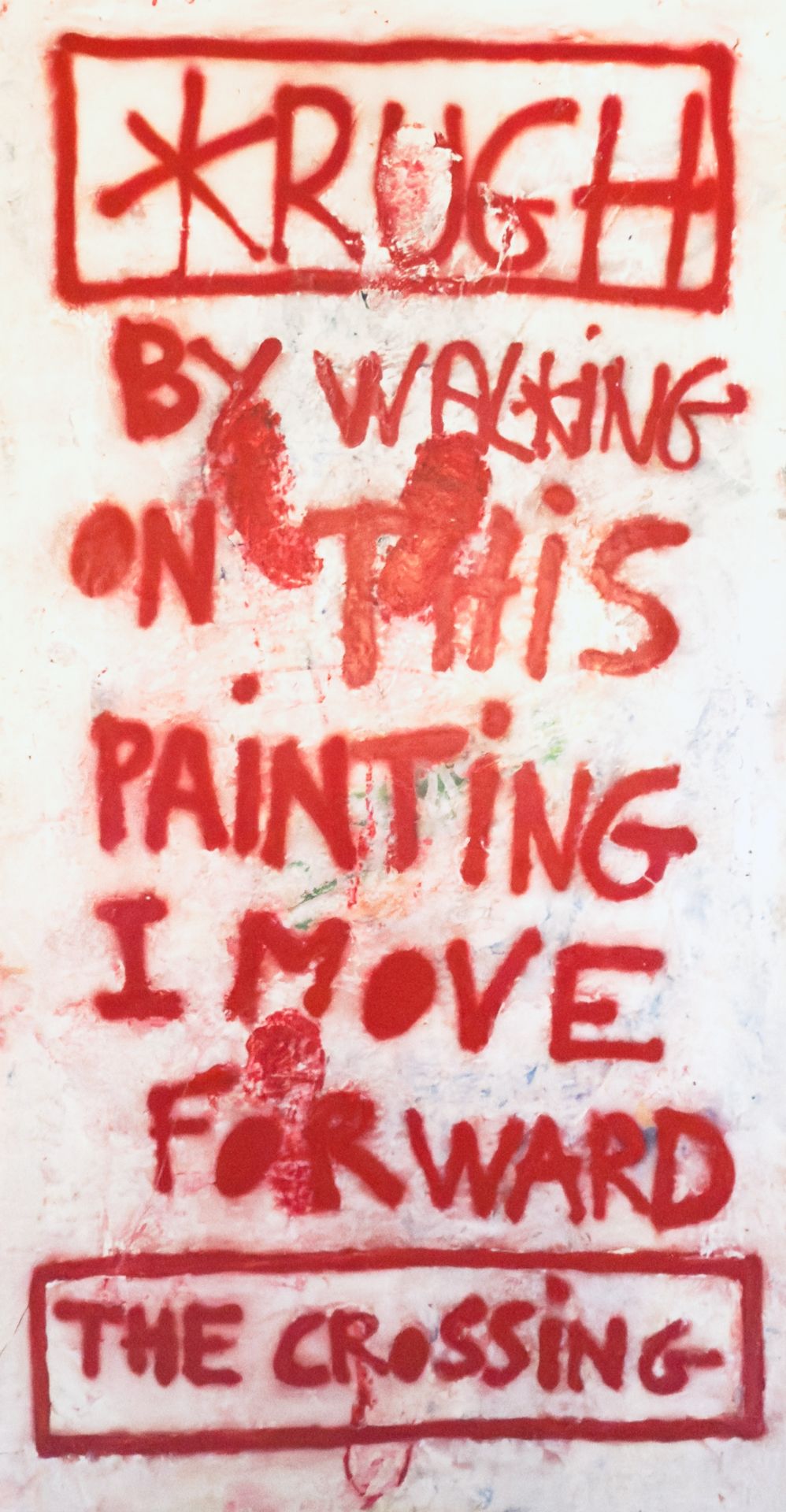
215x113