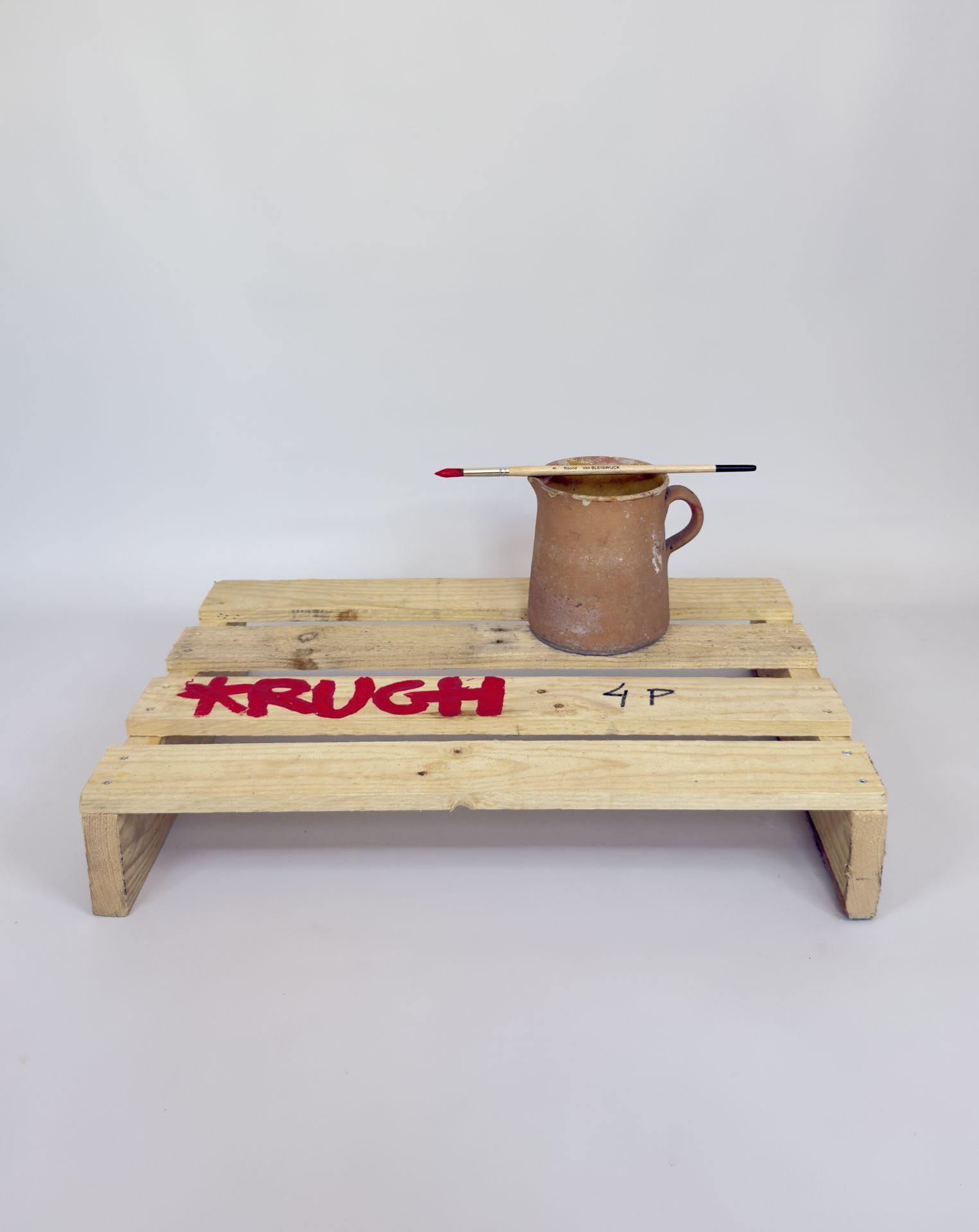
The palette
32x62x42
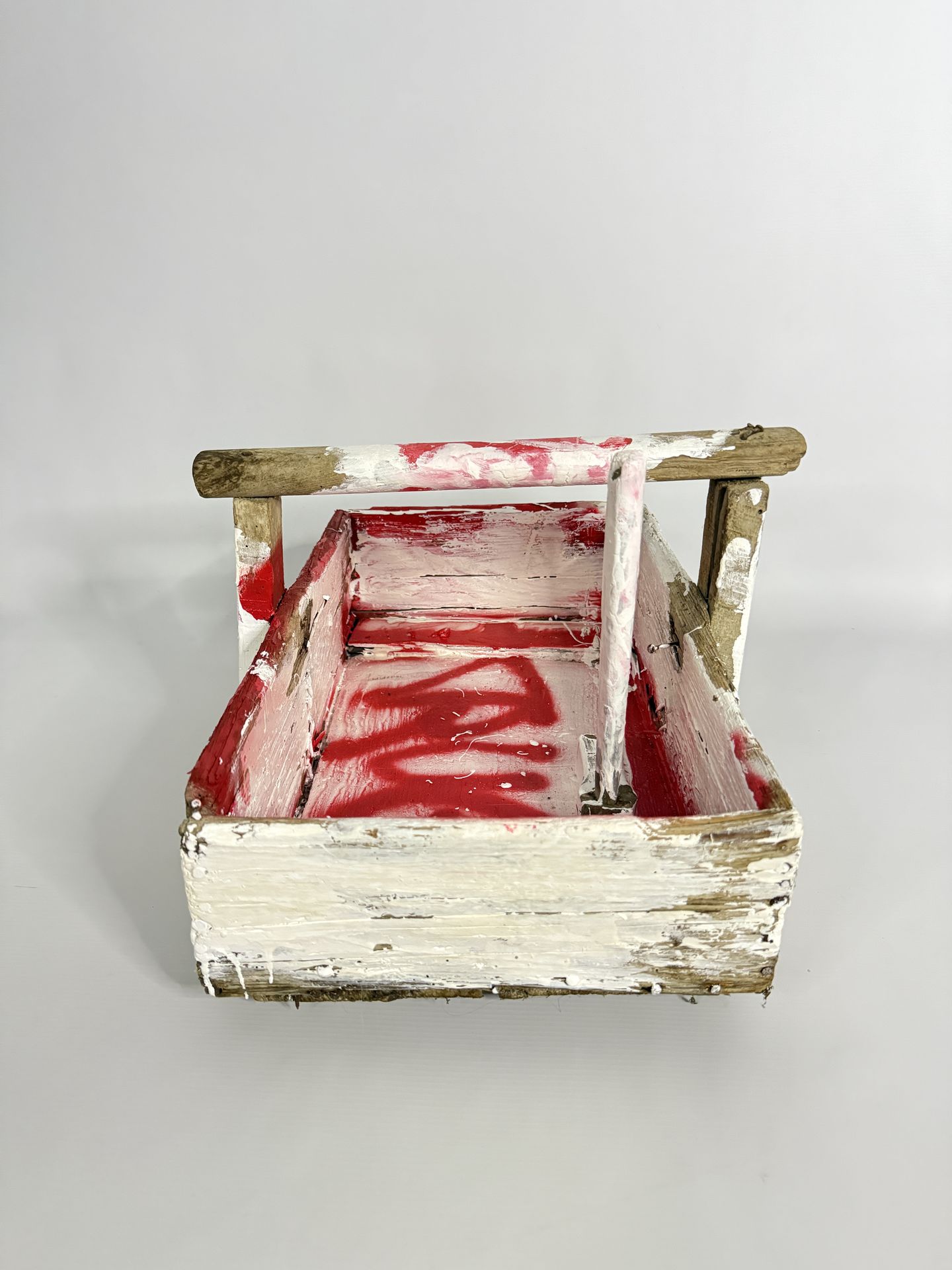
This small wooden palette, found abandoned, bears the red signature of KRUGH. More than a simple gesture it embodies a founding act - a "yes" inscribed in matter, trembling yet irrevocable. The red, overflowing beyond the line, becomes a flash, a shooting star, an impulse of elevation.
Both humble and sacred, the palette becomes altar, threshold and memory of an inner Annunciation. It marks the passage from art as practice to art as embodied vocation. Here, the name is offered as an offering, the breath is sealed and the rain that followed immediately confirmed its mark.
On the reverse side and within the material, signs have appeared - letters, numbers, hidden codes - traces of a secret language. The clay vessel that once held the red paint also bears the imprint : a silhouette, three points and the trace of a descending fire.
This palette is no longer a forgotten tool : it becomes the matrix of a commitment, the point of origin of a work destined to rise as a visual prayer.
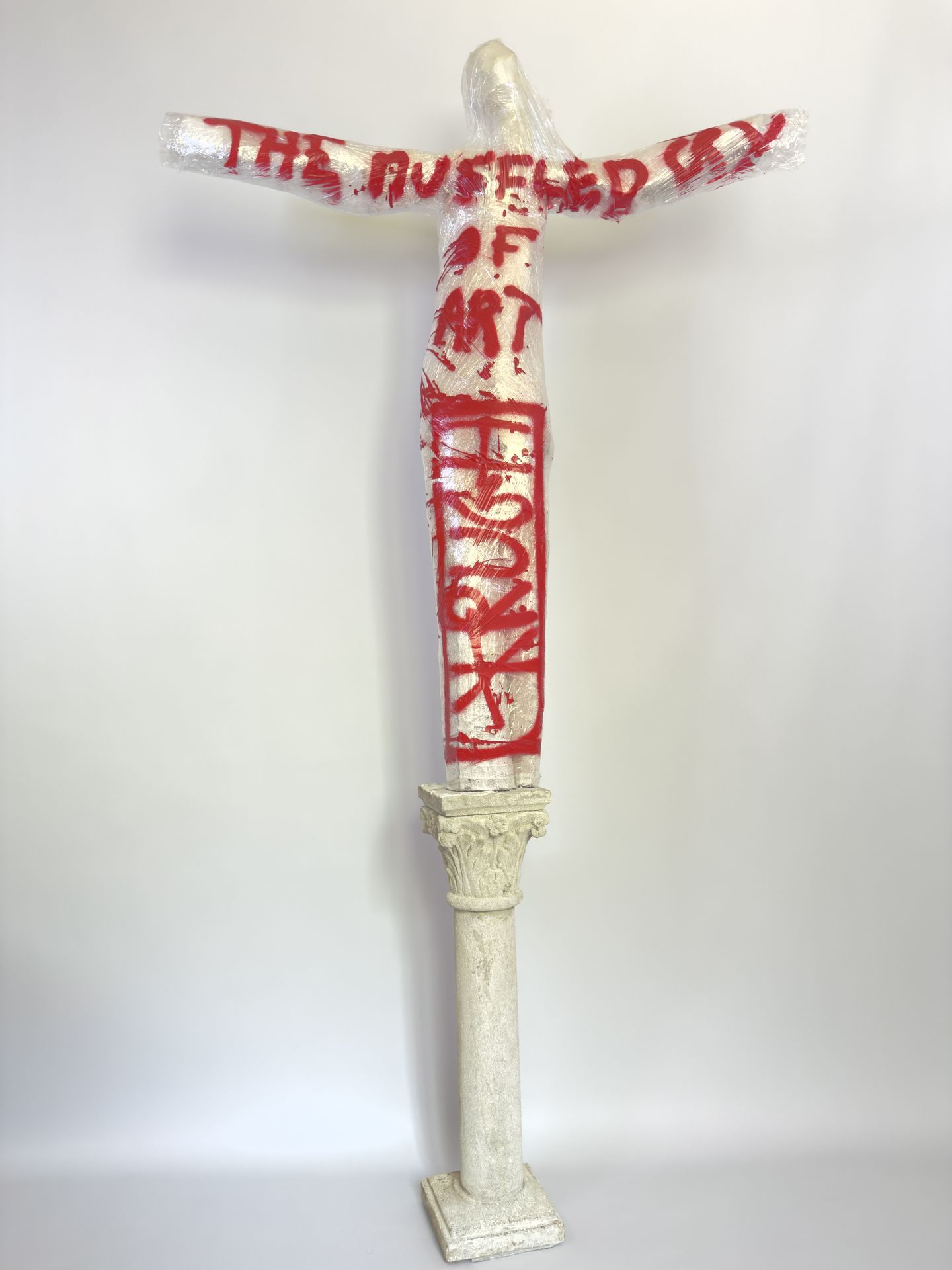
The cry of the venus of Art
190x103x25
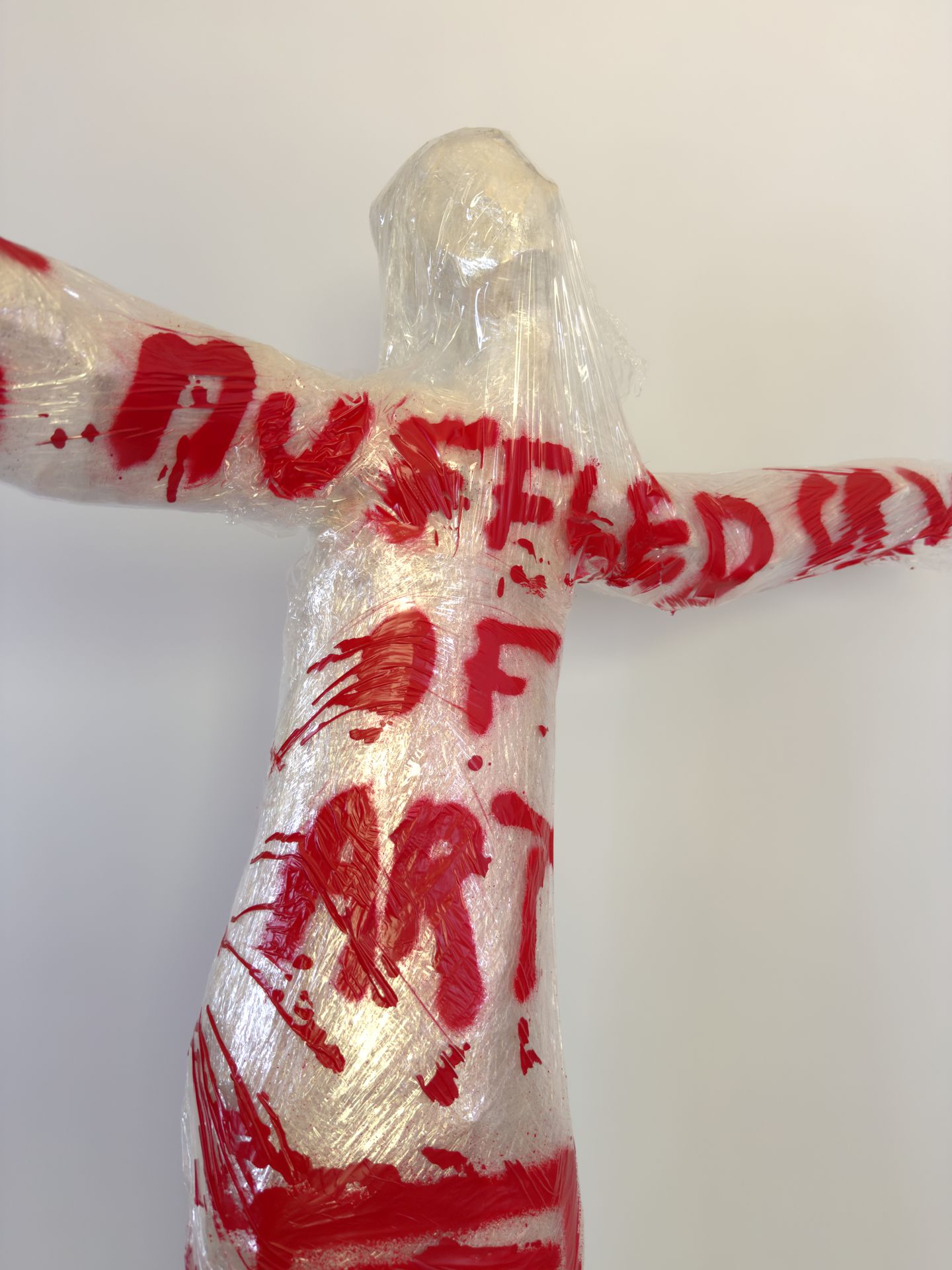
Erected on a column taken from the artist's childhood home, this crucified Venus bears the inscription The muffled cry of art. Made of wire mesh and strips of plaster, then wrapped in cellophane, it diverts materials of care and packaging to shape a broken icon.
Her body, swaddled and suffocated beneath the plastic film, evokes both bandaging and burial. She denounces the drift of contemporary art, which has too often become decorative — frozen in smooth, artificial surfaces. The incisive red slashes through this stillness: it signifies a refusal of silence and a revolt against art emptied of meaning.
Between intimate memory and a critique of the present, this Venus is no longer a symbol of ideal harmony: she embodies a stifled cry — that of an art striving to become alive and embodied once again.
The chair
135x68x80
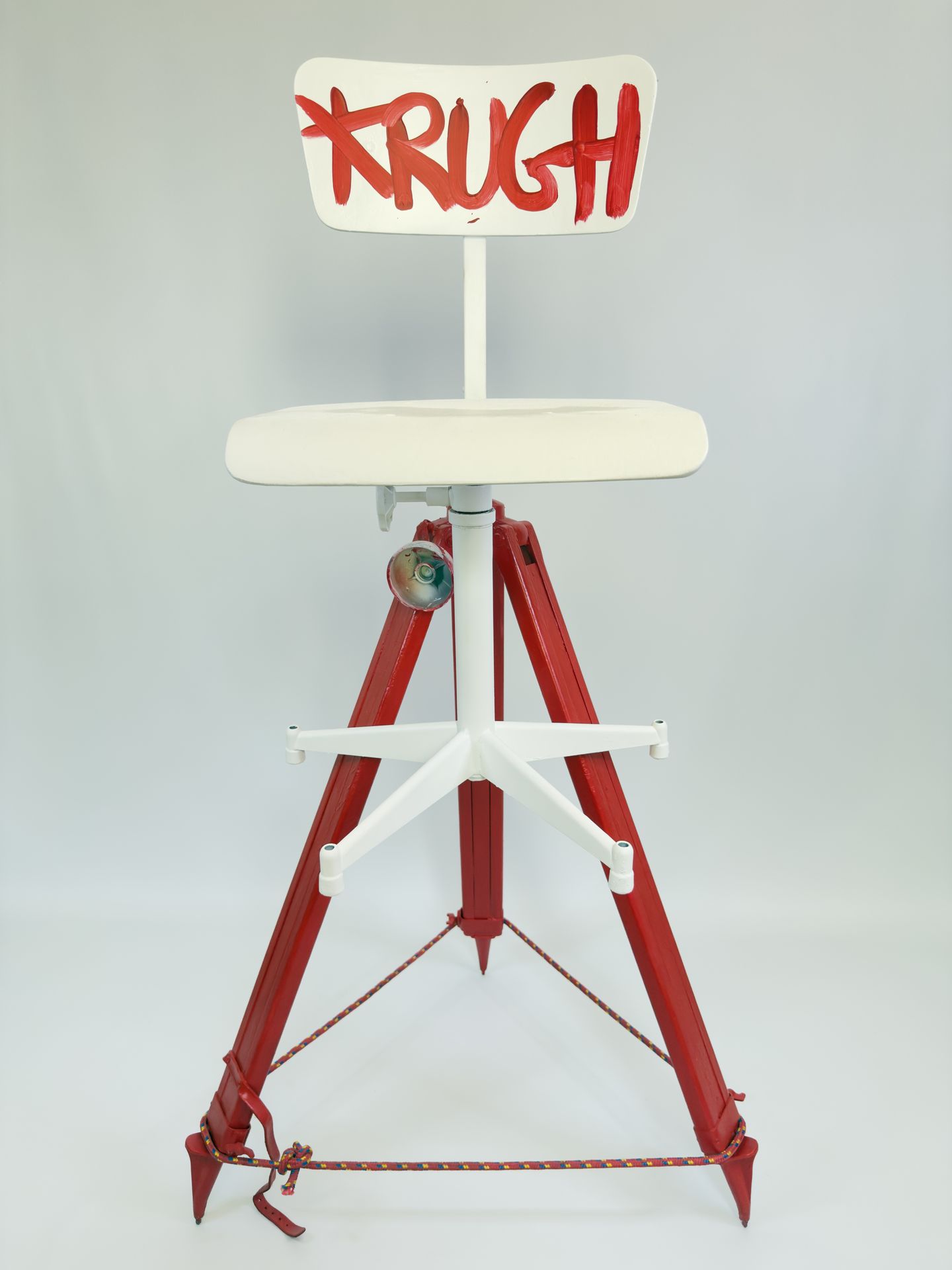
This chair, once used by the artist in her studio, is diverted from its original function to become a manifesto sculpture. Lifted from the ground and supported by a red tripod, it proclaims the liberation of utility and the invention of a new language.
On the backrest, the name KRUGH stands out in dazzling letters: the intimate support becomes a proclamation. Beneath the seat, a small cap suggests a mouth blowing — like an invisible presence lifting the whole structure.
Thus inverted, the everyday object frees itself from its original meaning and joins the artist’s own liberation: that of an art refusing confinement, claiming expressionist freedom, and allowing itself to be carried by something greater — through the fissure of the soul and the heart.
The Cry of the Vise
70x105x14
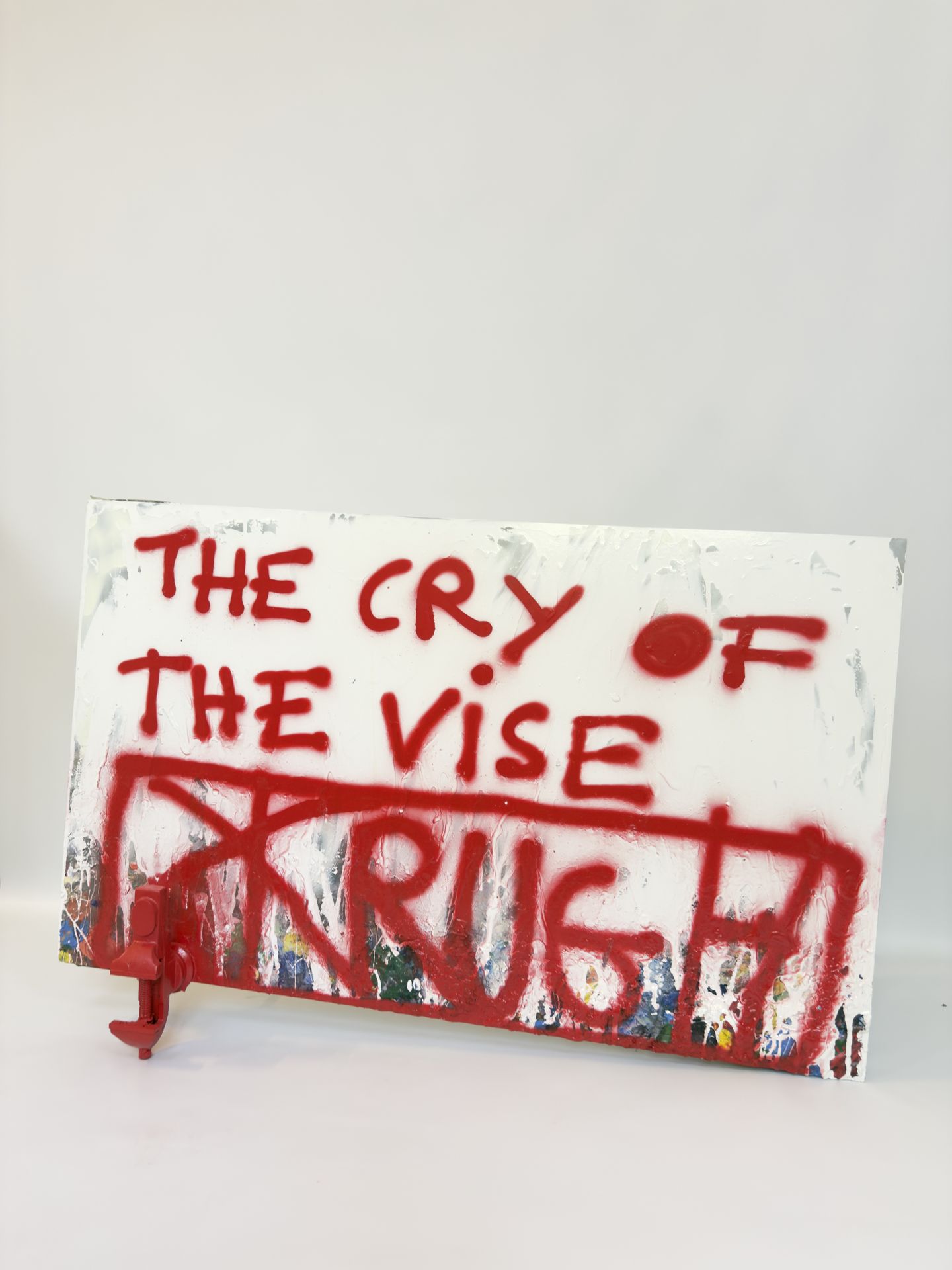
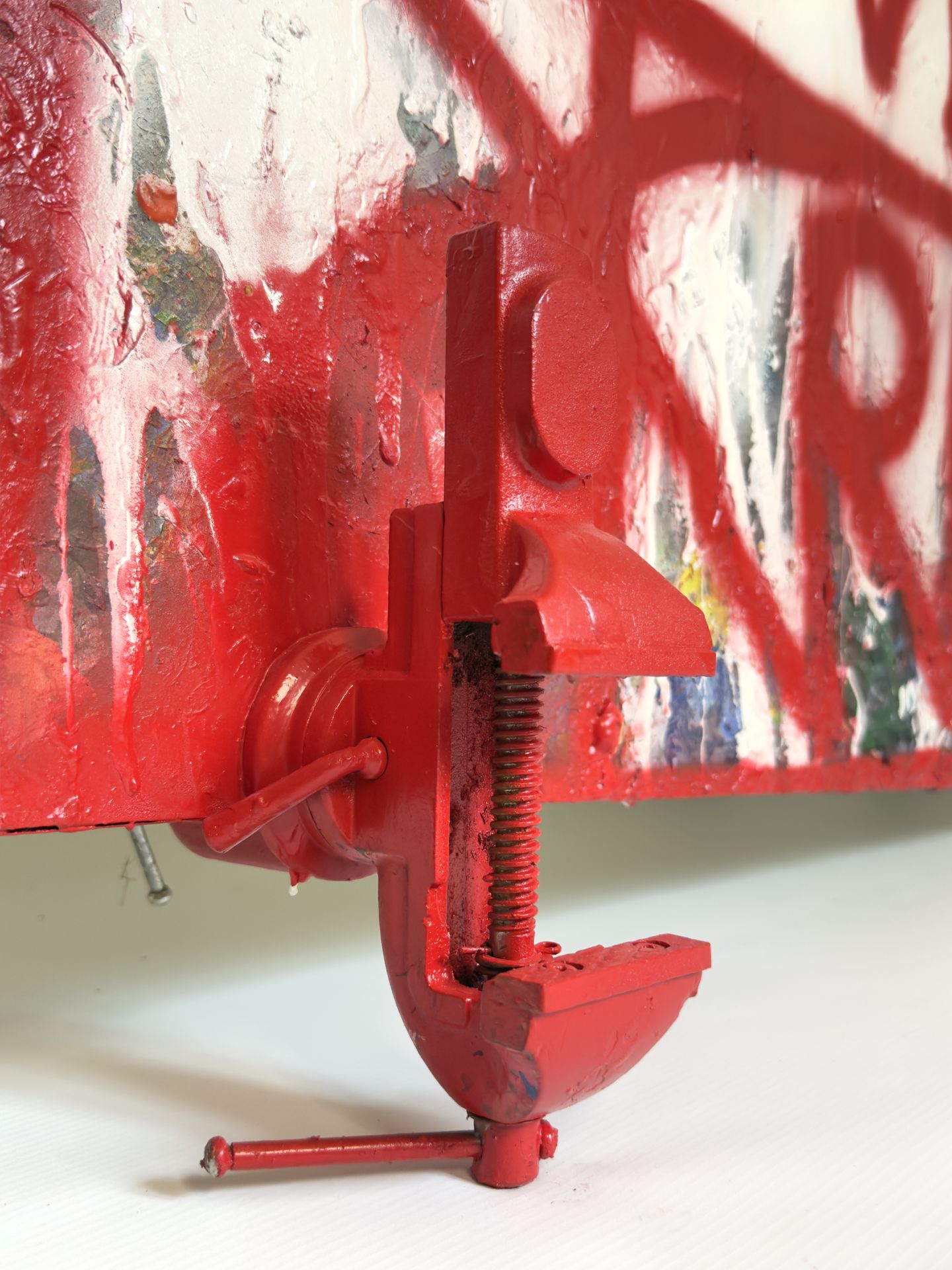
Born from the studio table where the artist once laid her tools and colors, this work marks a turning point. In a gesture of anger and emancipation, the workbench is overturned — a refusal of art’s corruption, its complacency, and its well-mannered codes.
Across the splattered surface, the cry is written in red: The Cry of the Vise. The vise, painted in the same color, opens like a gaping mouth, finally releasing the pressure. From an instrument of constraint emerges an image of deliverance.
This cry resonates with the artist’s own life — a moment when her breath seemed stifled, her voice unheard. Here stands a radical decision: to create no longer according to standards, trends, or systems of evaluation, but to give voice to something embodied, alive, and irreducible.
Here, in the crash of overturning, a radical affirmation bursts forth: “this cry is me.”
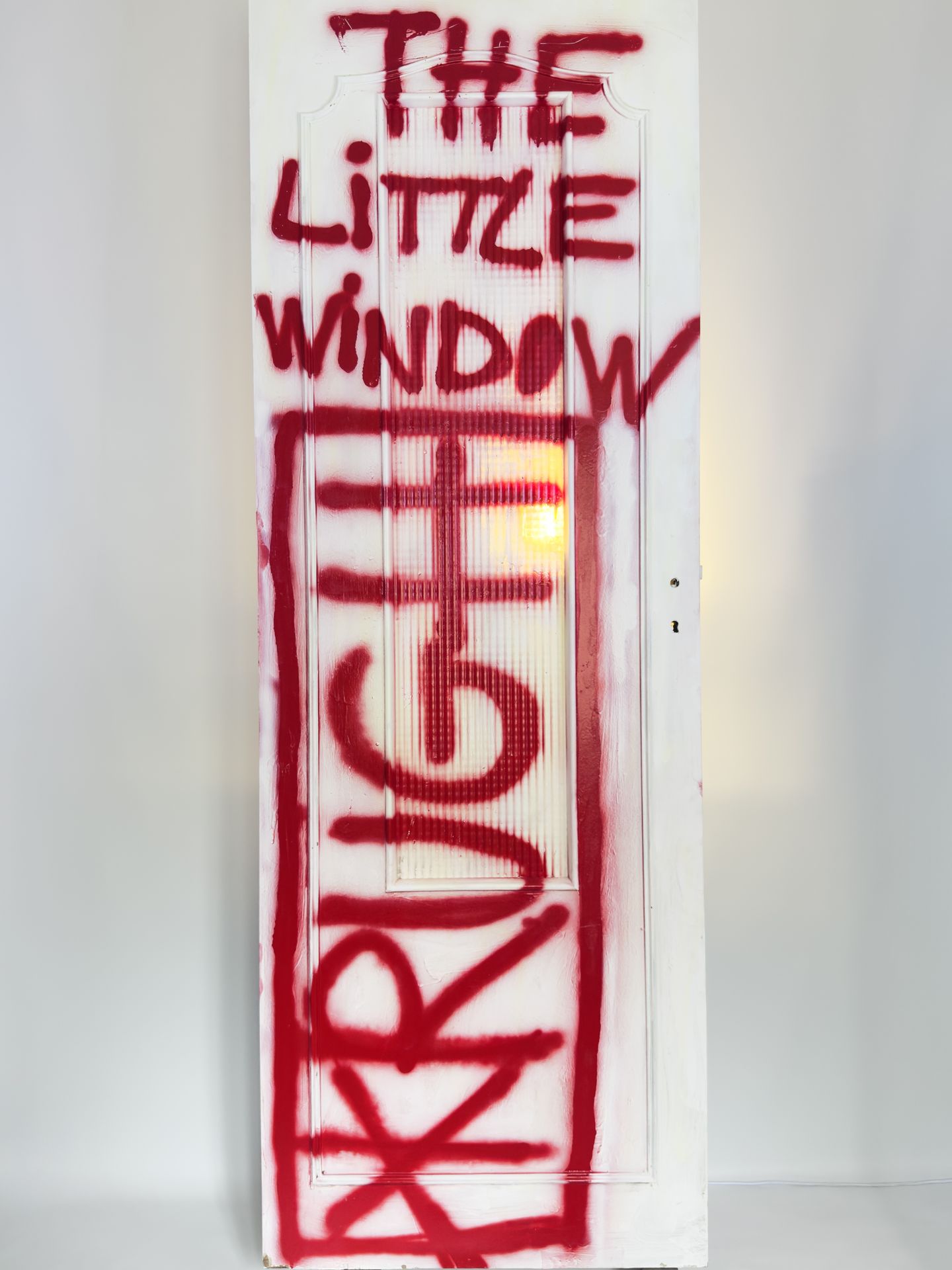
The Little Window
235x75x52
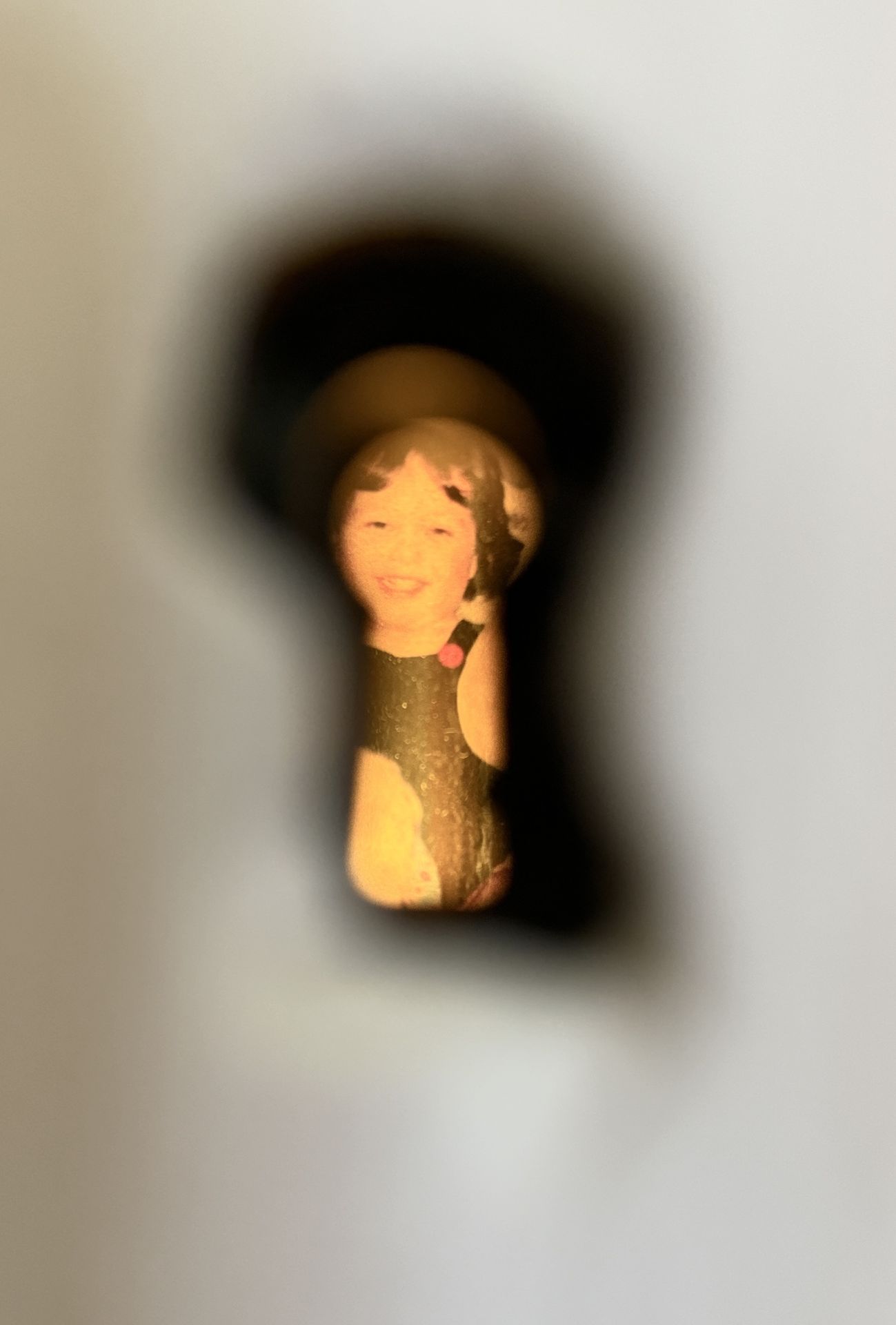
This door, taken from the artist’s childhood home, opens onto an intimate installation. Behind the red-painted surface, light seeps through a small window, and in the shadow of a keyhole appears the photograph of a child — the artist himself, in the joy of his earliest years.
The installation is based on an old easel from his studio. This support, a discreet witness to his journey, becomes the pedestal for this small window opened onto childhood, connecting the child to the artist.
To see this image, the viewer must bend down, lean forward — as one would toward a child. This simple gesture brings them face to face with the artist’s inner child, and perhaps with their own. Behind life’s ruptures, wounds, and trials, this light endures: the child as he once was, as he has become, as he still remains.

Invisible Visible
28x40x15
An old trowel. An old nail — the one that belonged to his grandfather, a builder.
From the front, almost nothing can be seen: a whitened, marked surface, like silence itself. But by shifting one’s position, by taking a step to the side, the nail appears — the planted wound, the piercing point.
So it is with suffering: it is not always visible. It hides behind surfaces, beneath the plaster of everyday life. Yet for those who accept to shift their gaze, the hidden meaning is revealed.
This work thus becomes evocative of the Christic mystery: the invisible nail that pierces the flesh of the world, the hidden wound that carries within it a revelation.

The call
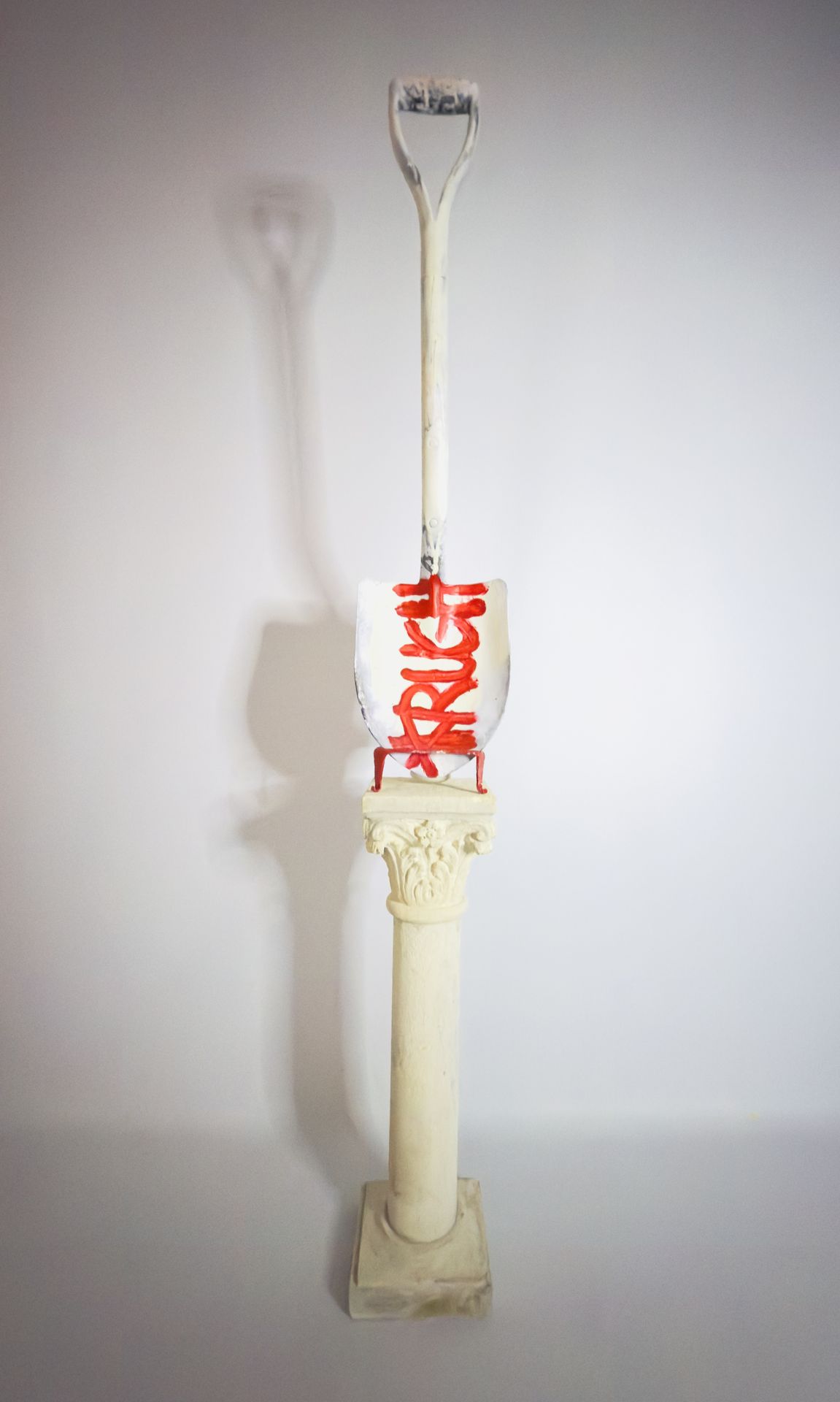
165x25x18
On a column from his childhood, the artist erects a family shovel, discovered among old objects — likely his grandfather’s — diverted from its original function.
A tool of labor and digging, it here becomes the Call: a sign of a vocation to go beyond surfaces, to open a passage between the visible and the invisible.
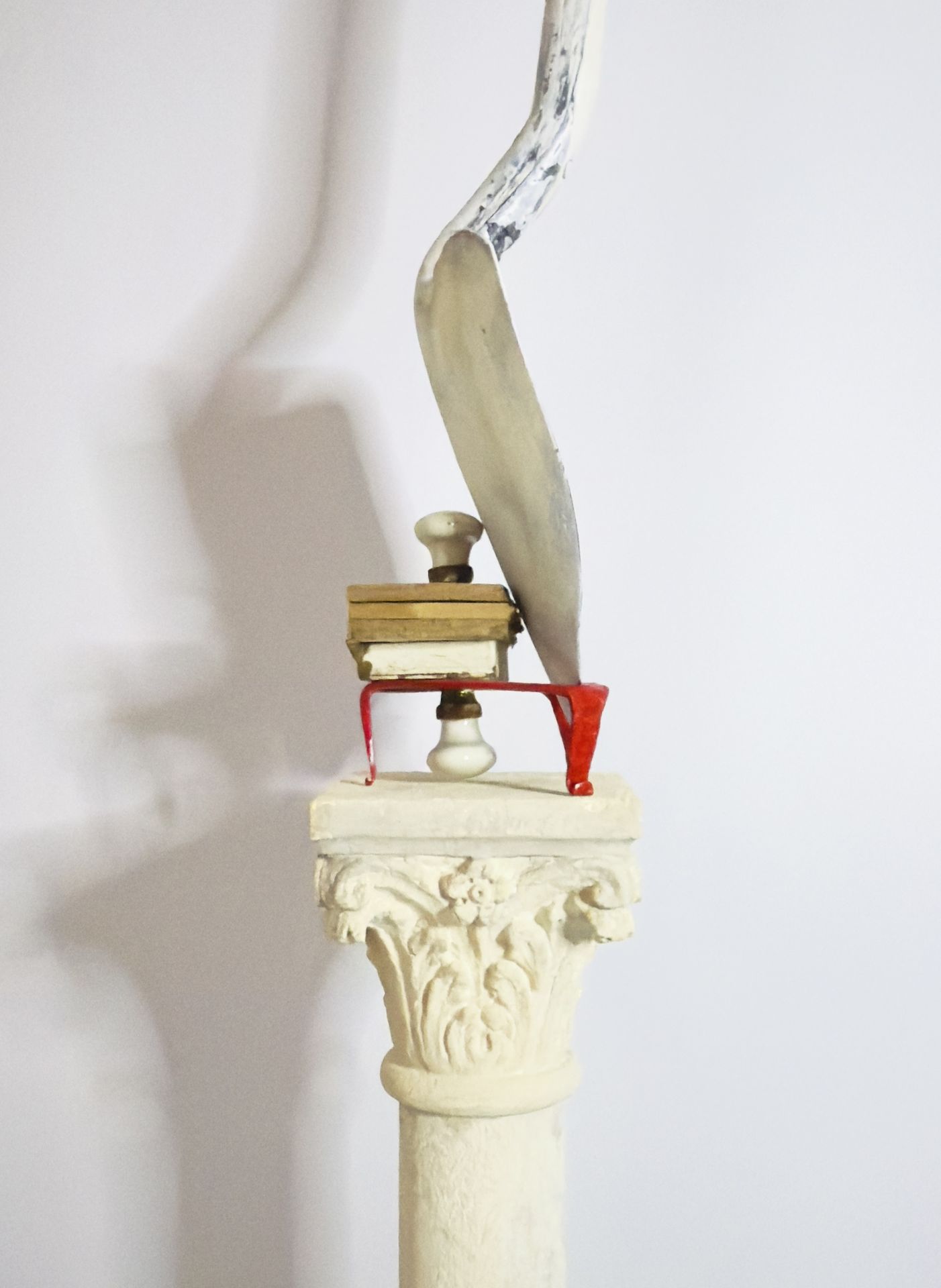
The name KRUGH is inscribed in red on the white blade, like a mark emerging from the material. At the base, a red triangle supports the balance of the whole, evoking a foundational tension that lifts more than it restrains.
A double handle appears at the back, like a silent door, open between the visible and the invisible, reminding us that this passage is not closed but offered. Between labor and elevation, earth and sky, this shovel affirms a freedom: that of the artist who digs to bring forth what remains hidden.
Invisible Visible | La Boîte
28x40x15
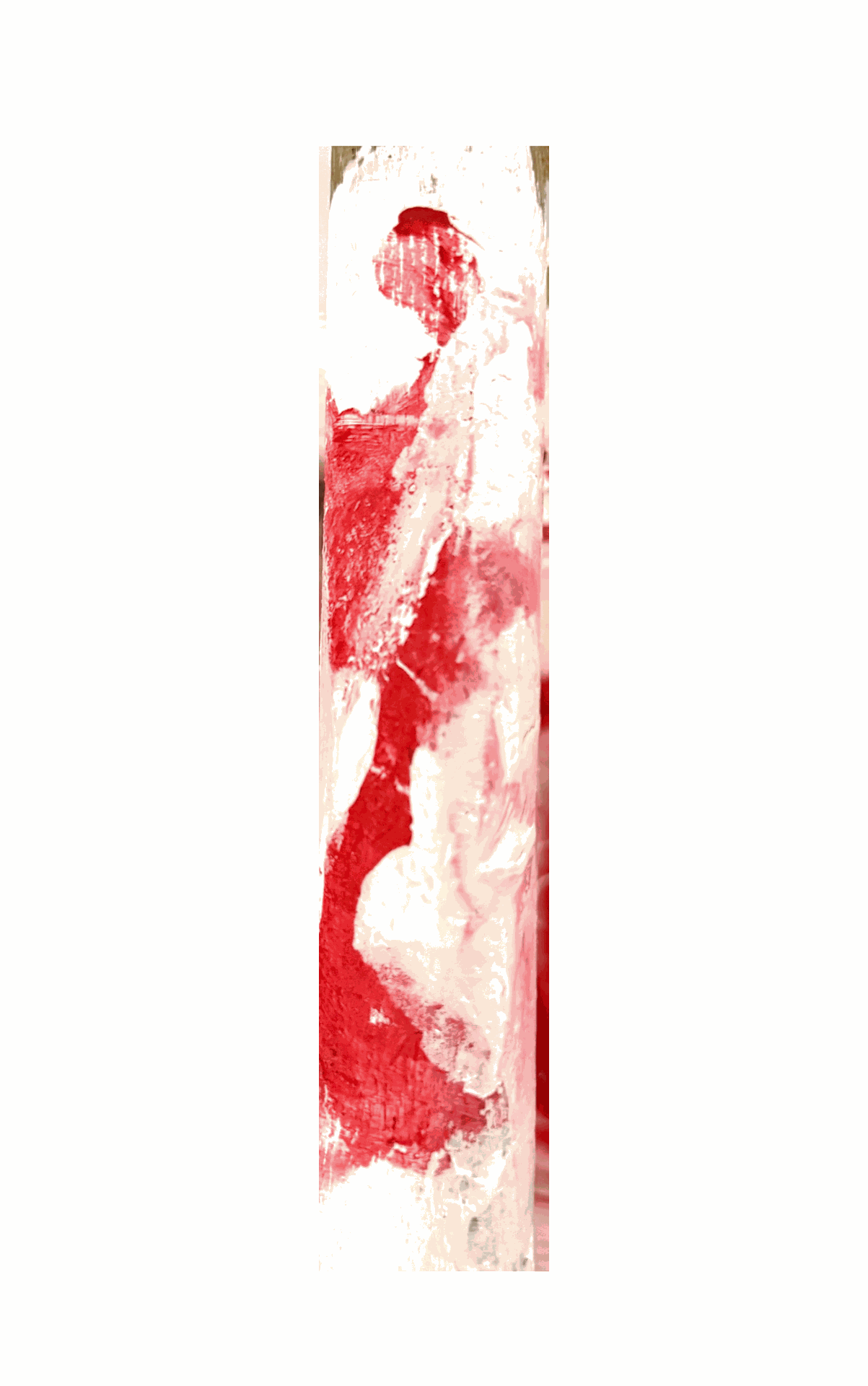
Next to the trowel, a toolbox. It once held the hammer that struck the nail. When grasped, the artist’s paint-covered hand left an imprint: a red-and-white silhouette, like a Christic figure. One can fully discern it only by bending down and stepping to the side, as if the act of seeing required a gesture of humility.
Here’s a faithful and natural English translation in the same style as your previous texts: --- These two objects — the trowel and the toolbox — respond to one another. They carry the memory of labor and suffering, the inherited legacy, and the discreet revelation of a presence. *Invisible Visible* is not merely a work, but a passage: the nail that pierces and the figure that is imprinted, the wound and the visitation, a memory of wounded humanity and a sign of a mystery.
Not Concept, Just Me
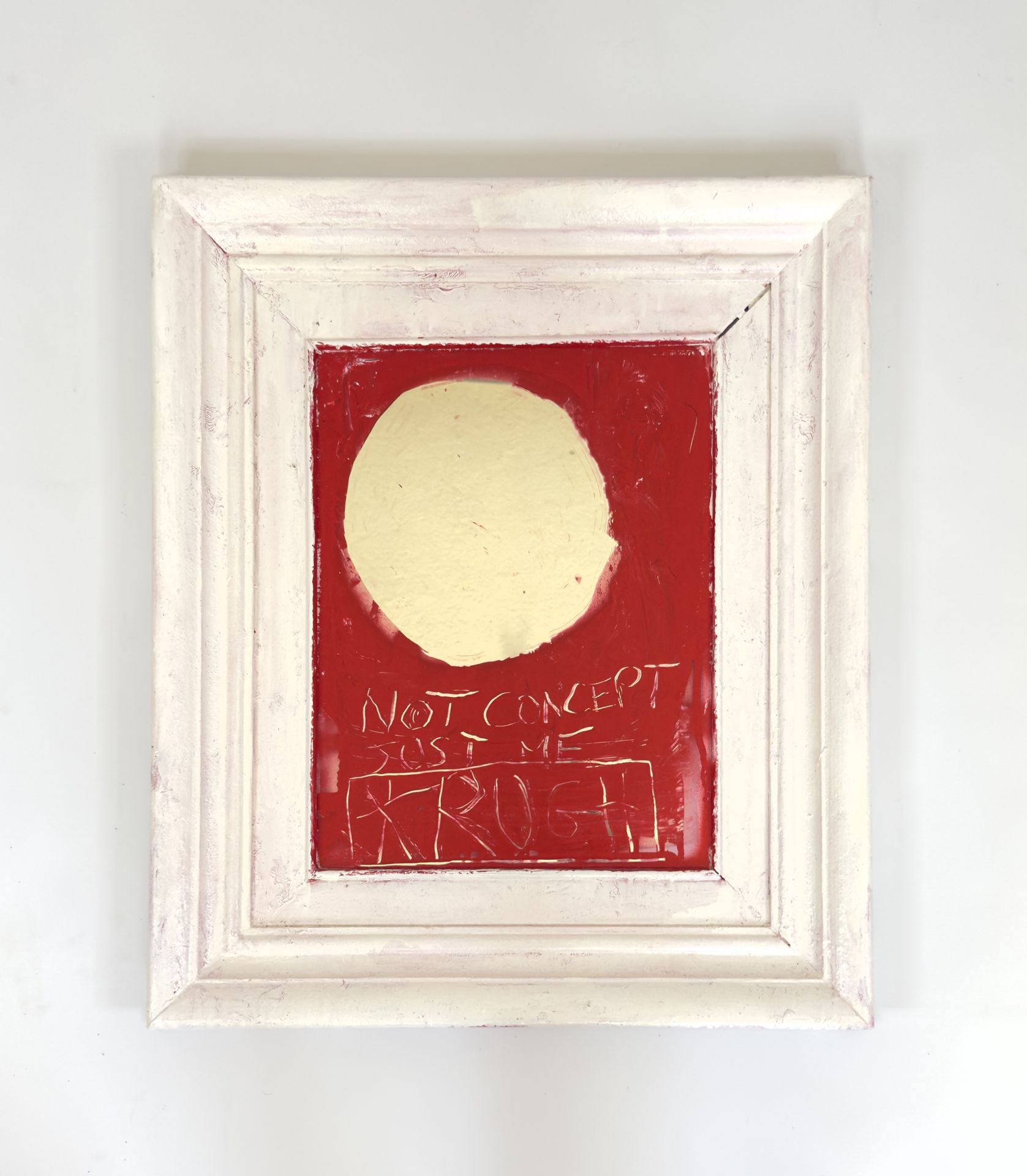
62x51x4
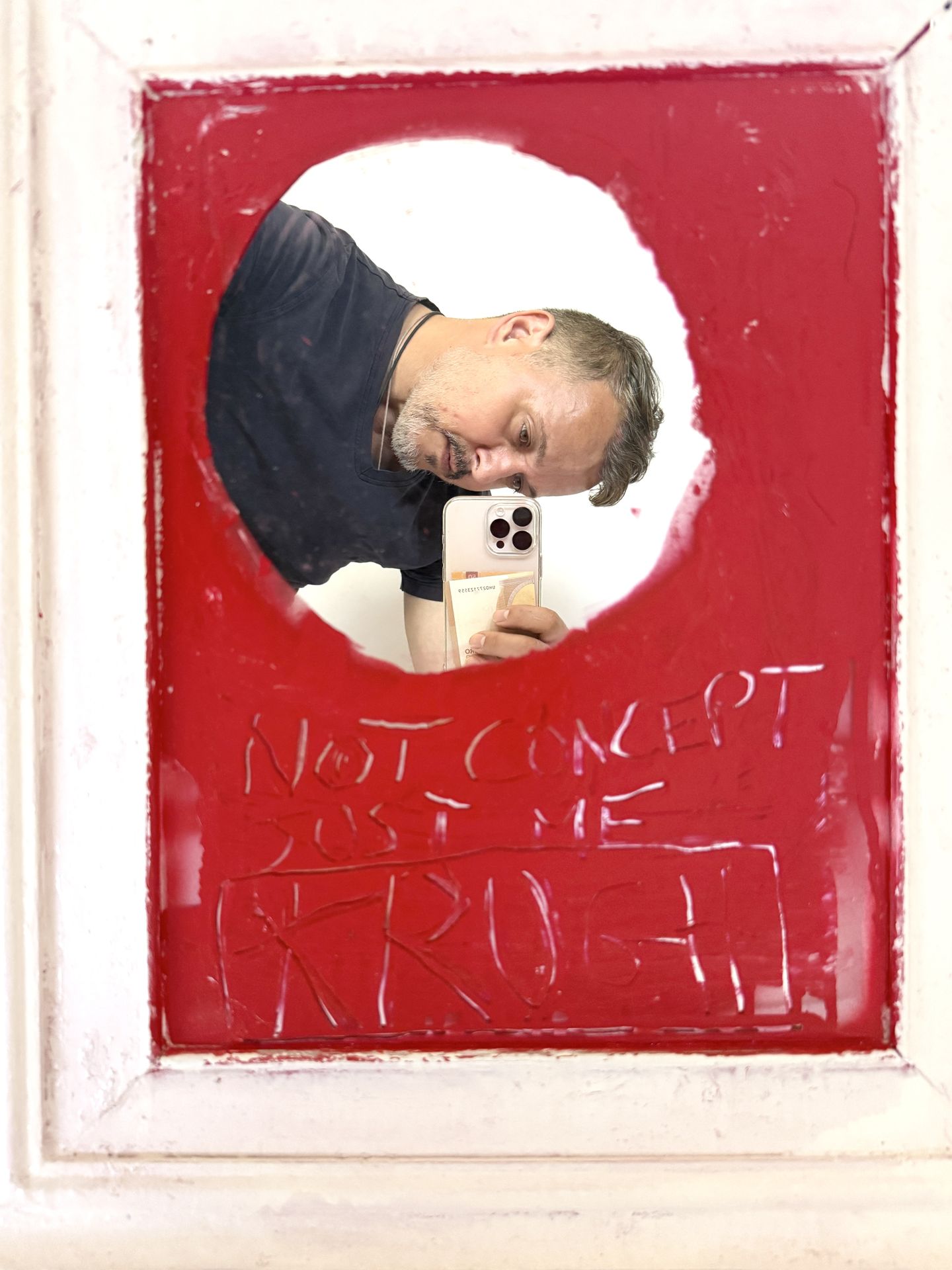
A circle left empty, like an open skylight.
An engraved phrase : Not concept, just me.
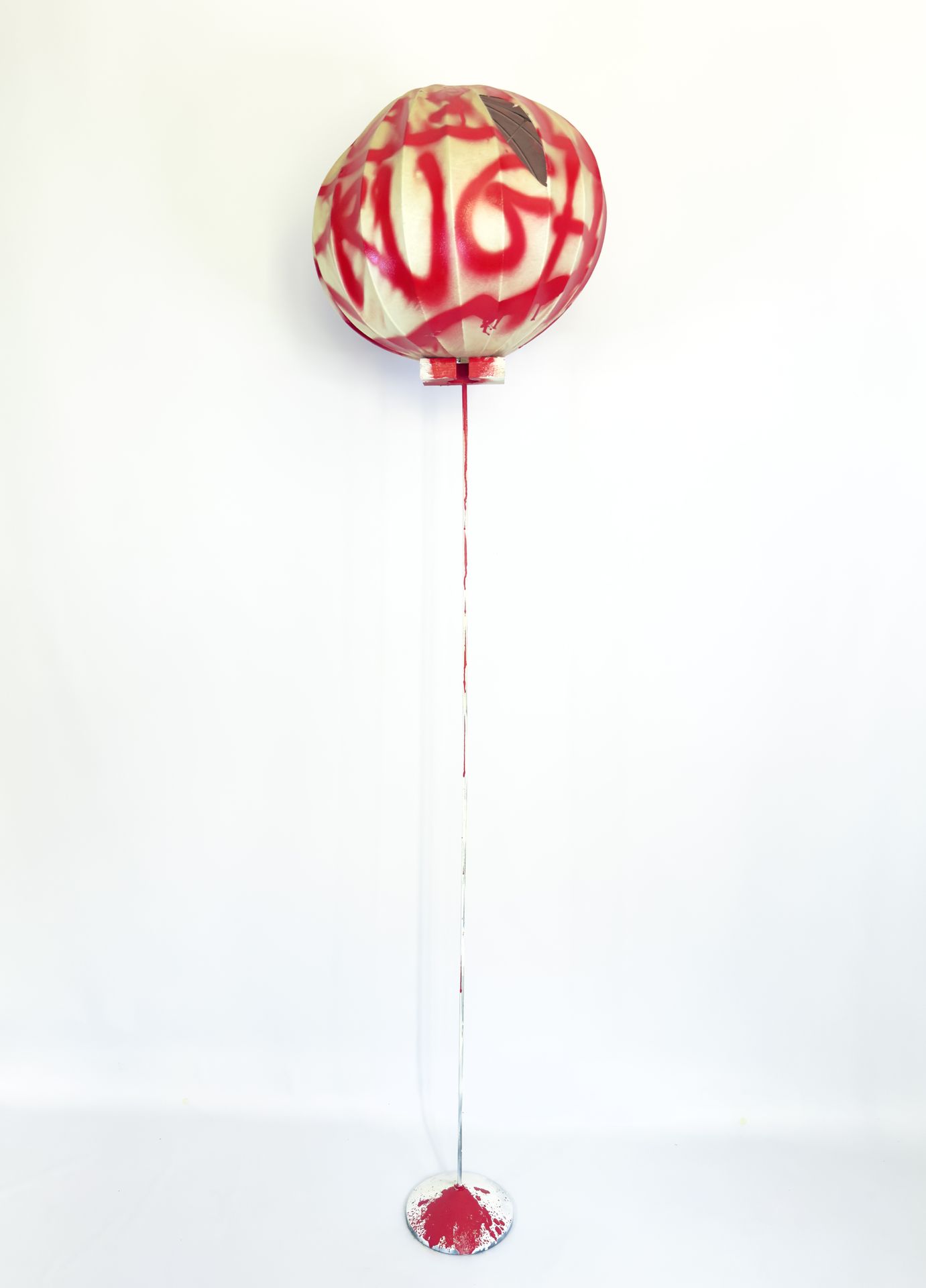
TRA$H
191x47x47
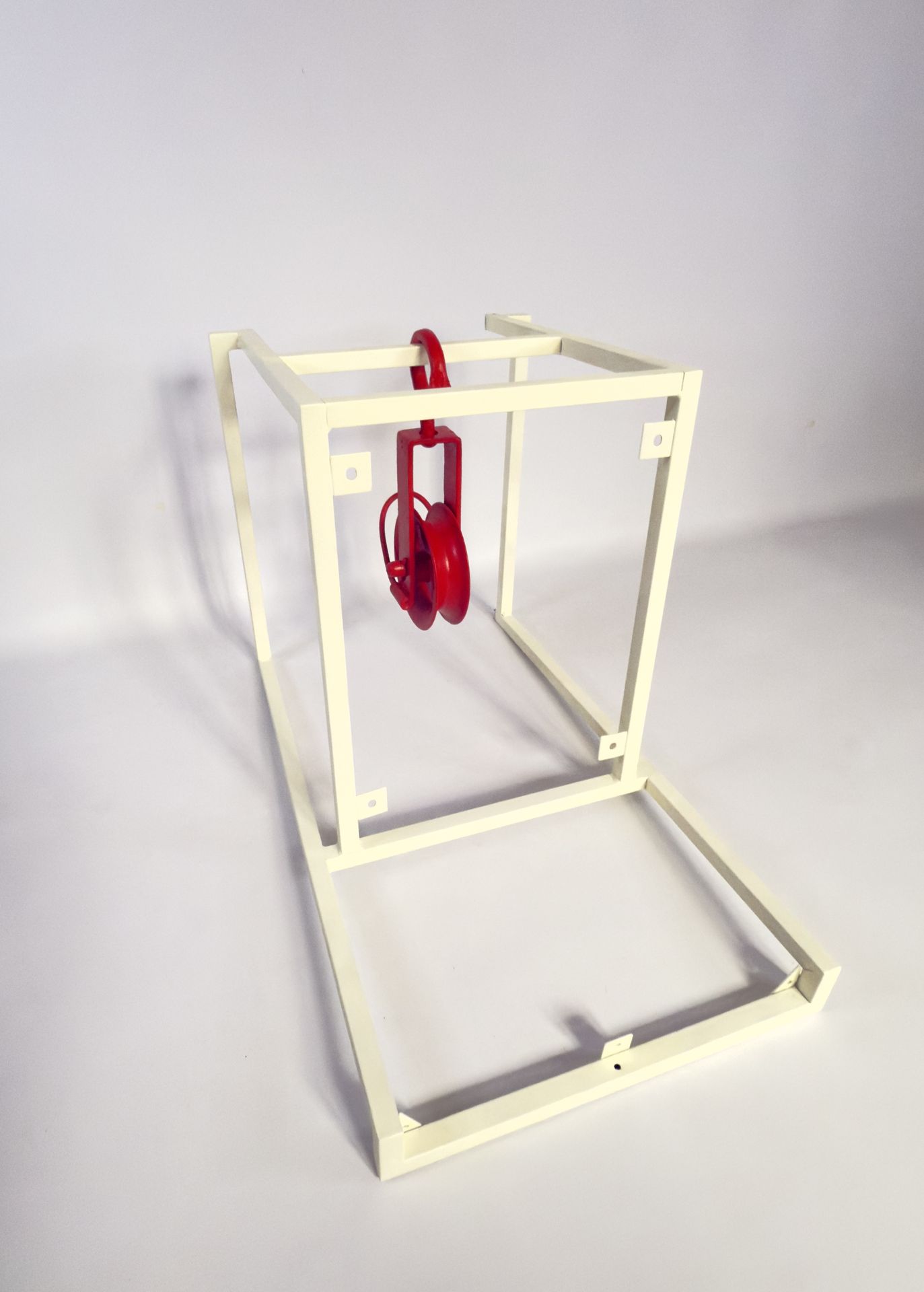
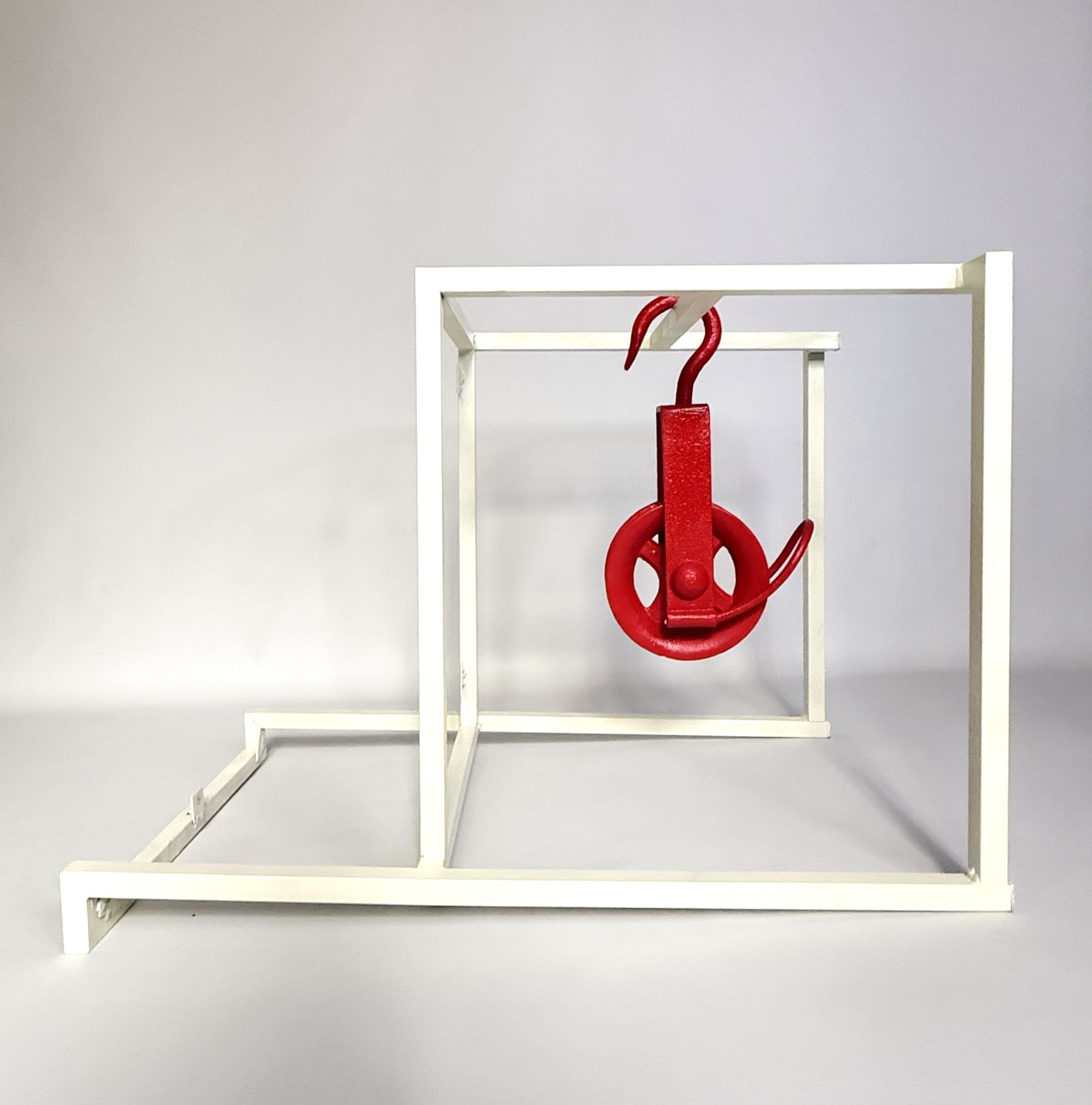
Overturned chair with winch
49x66x33
An overturned chair refuses comfort and conformity. It is no longer a place to sit but an open, unstable frame, unsettling the established order.
At the center, suspended, a winch inherited from his grandfather. It becomes the living heart of the work, the point of gravity and memory. The winch plunges, lifts, pulls inward. Unlike the motionless seat, it embodies movement, effort and depth.
This work questions the fragile balance between stillness and tipping.
It poses a simple yet radical question : what must be overturned for something to truly begin to move — in art, and beyond art ?
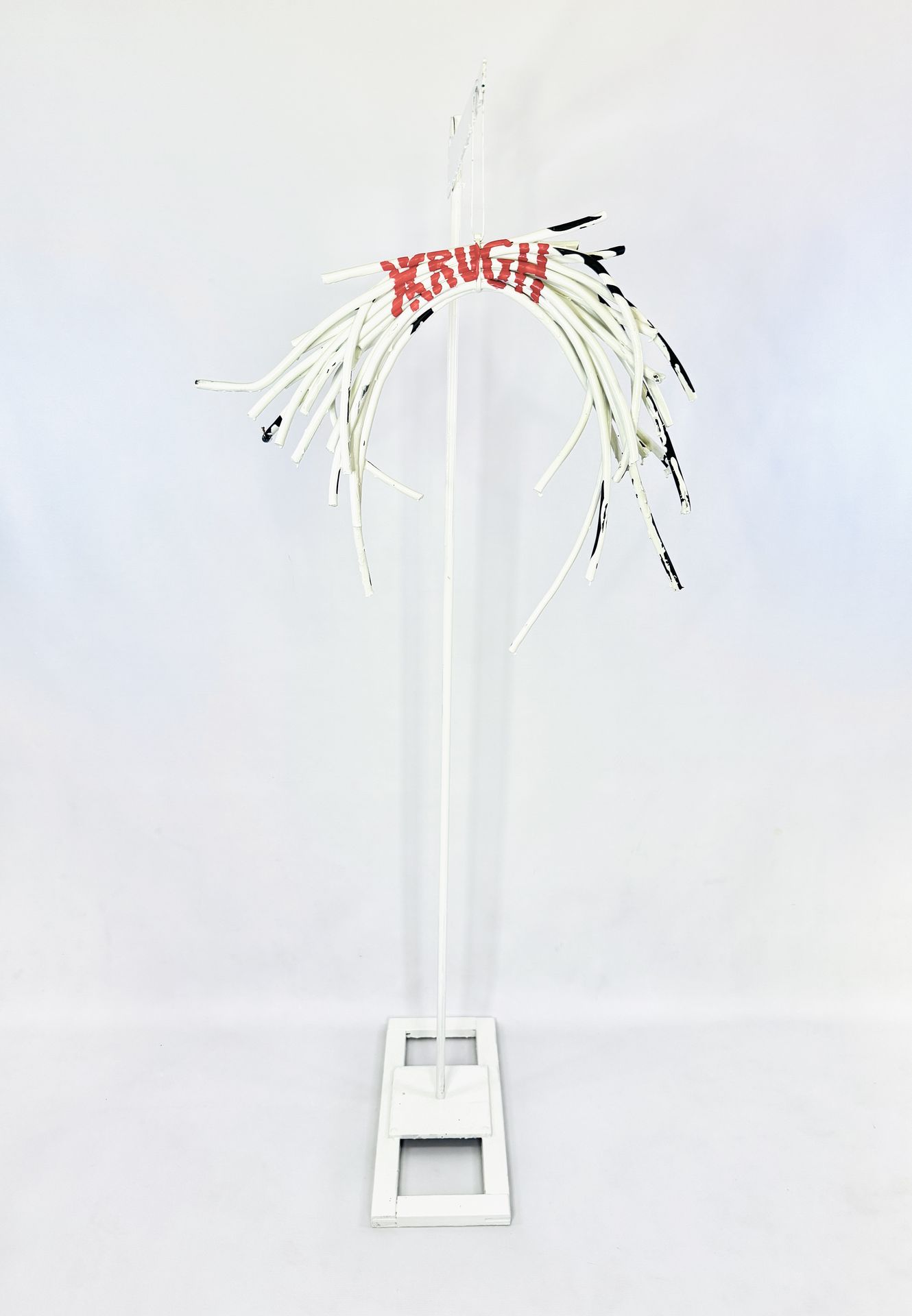
Disconnection
150x52x57
A bundle of cables suspended, like nerves torn from the heart of the material. The wires strive to connect, but some remain open, discordant, impossible to join. The artist’s signature has attempted to create a link, yet gaps remain — free, irreducible.
The gallows, with its shape and paint drips reminiscent of a saw, becomes an image of rupture. It evokes both voluntary and imposed cutting, the sharp edge that separates. We live in an age saturated with connections — networks, messages, instant encounters — and yet real relationships are weakening. Human bonds break faster than ever: in couples, in families, in friendships, anyone can vanish with a click, disappear from one day to the next.
This sculpture carries this tension: the desire to connect, to gather, to weave — yet encountering the other’s freedom, their power to sever. It exposes the pain of a broken bond, but also the honesty of this reality: no technology, no will, no material can prevent the void if one chooses silence.
Suspended, light, and painful at once, Disconnection reminds us that true connection is never guaranteed, that it is fragilely built between two freedoms, and that its loss opens a vertigo that touches us all.
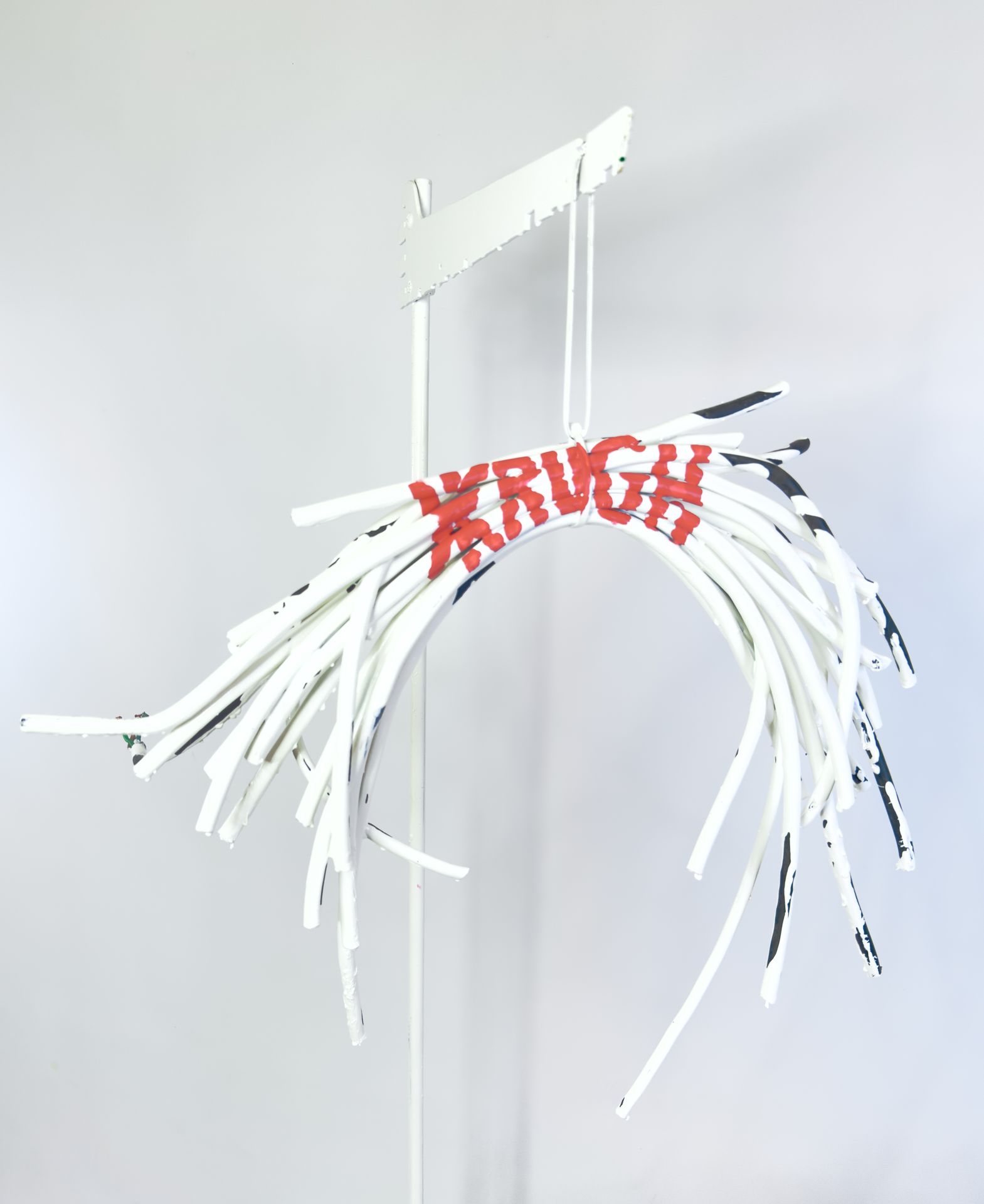
H of KRUGH
138x35x75
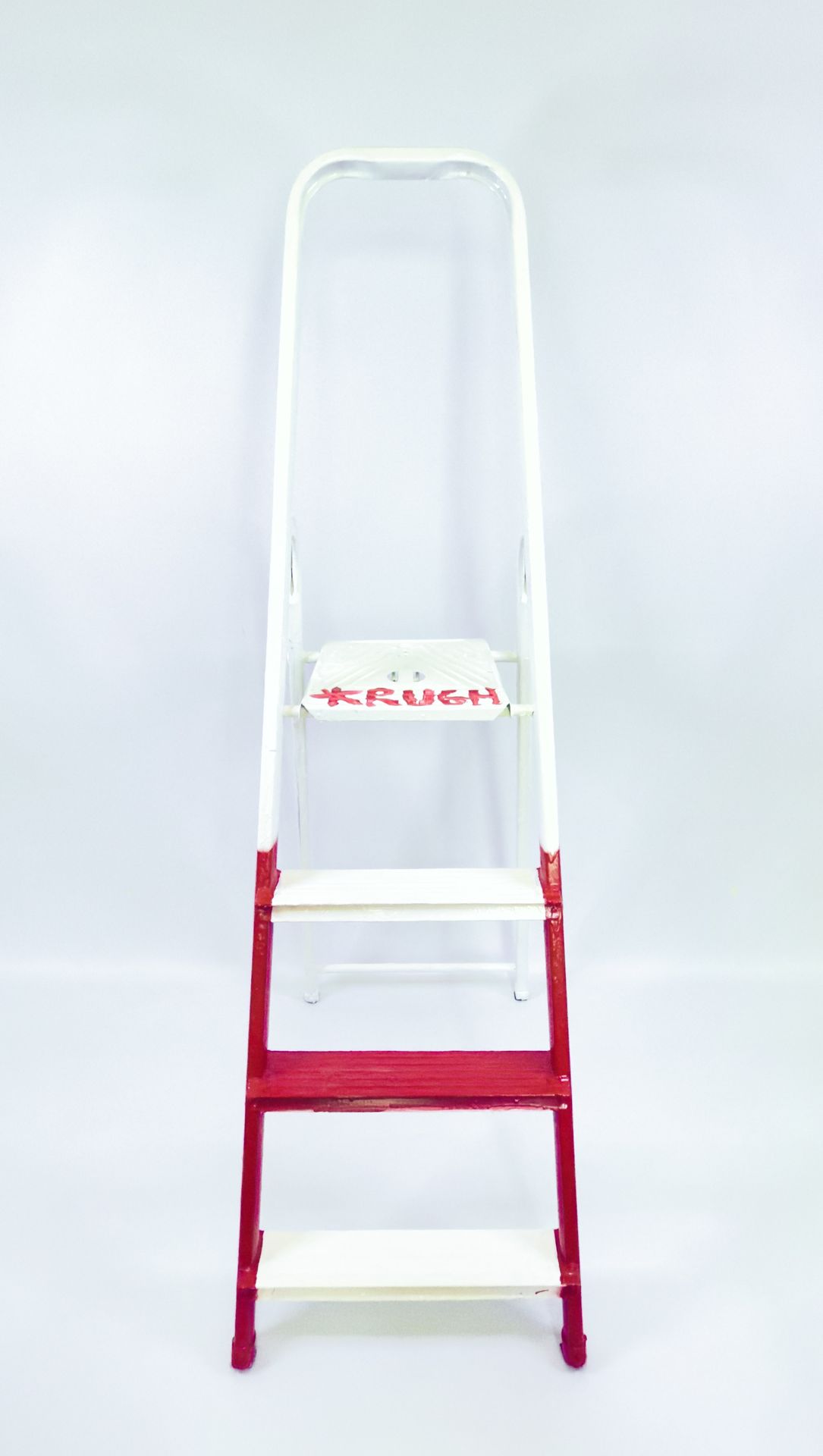
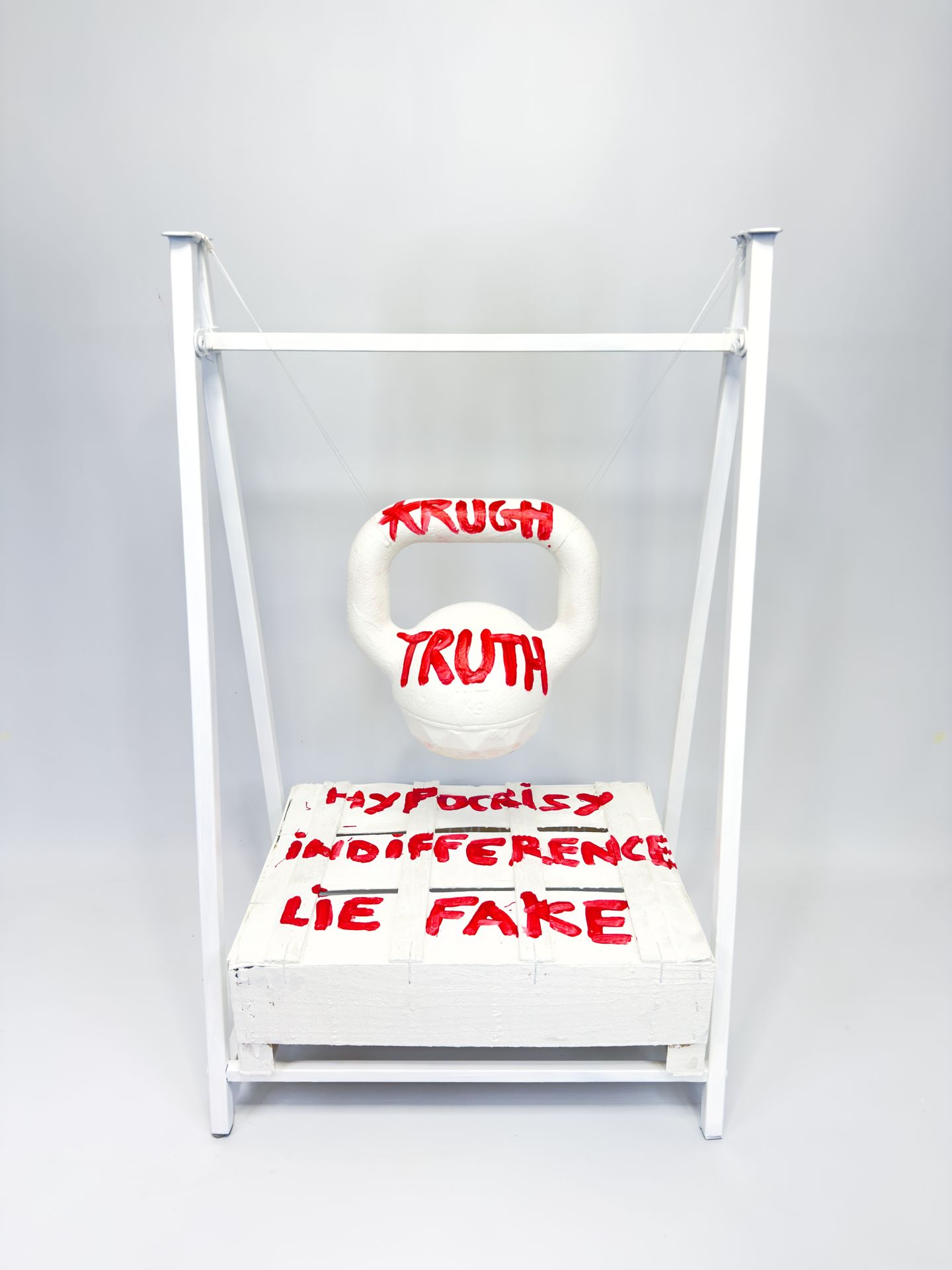
TRUTH
75x45x31
Suspended, a white weight of 12 kg marked with TRUTH hangs above a fragile crate where hypocrisy, indifference, lie, fake are inscribed in red.
The balance seems precarious. The truth, heavy, could at any moment come crashing down and shatter the illusions.
But for the moment, everything remains suspended: tension, waiting, silence.
The spectator reads the words through overlays, sometimes masked, sometimes visible. Like in life, hypocrisy never reveals itself all at once: one must shift their gaze, seek the right angle to see clearly.
Simulacrum, a mirrored reflection of the palette, the work stands between fragility and sentence, between revelation and collapse.
It raises an essential question: how much longer will the truth remain suspended ?
And more deeply: how much longer before a turning of the heart, in a world sometimes mute and deaf to the truth?
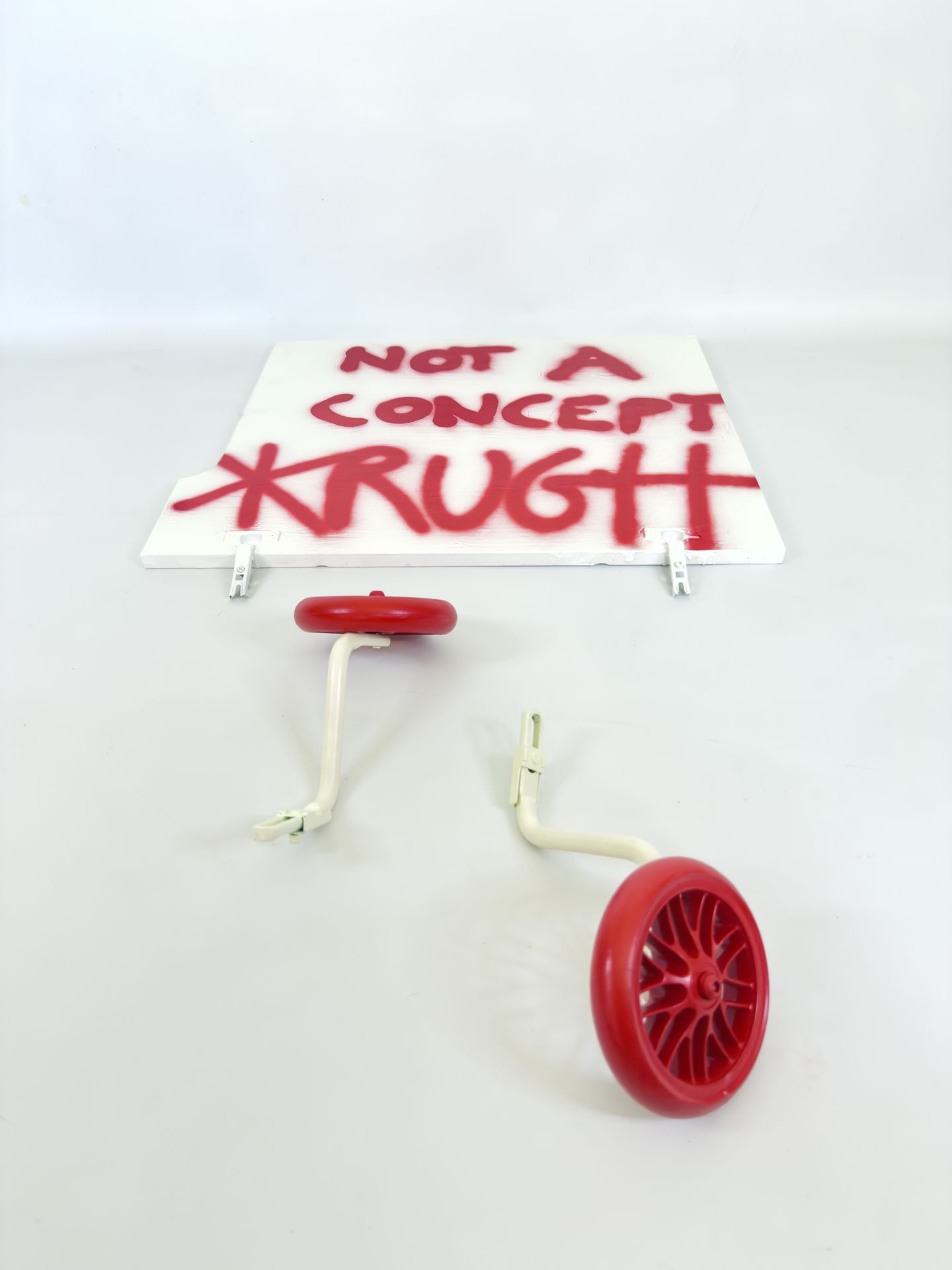
The torn door and the small wheels
10x95x58
The heart and soul of the work no longer remain behind closed doors; they overflow and are laid bare. The torn door holds back nothing: the interior bursts forth, without a façade.
The small child’s wheels, detached, evoke learning and precarious balance. But they are now laid on the ground. As if the artist declares their work with no further restraint, embracing the audacity of bare risk, without compromise.
In red, "NOT A CONCEPT" proclaims a refusal: it is not an abstract idea, but a living experience. The work presents itself as a tearing away and a freedom: nothing is held back, nothing is concealed — everything is delivered, raw, alive.
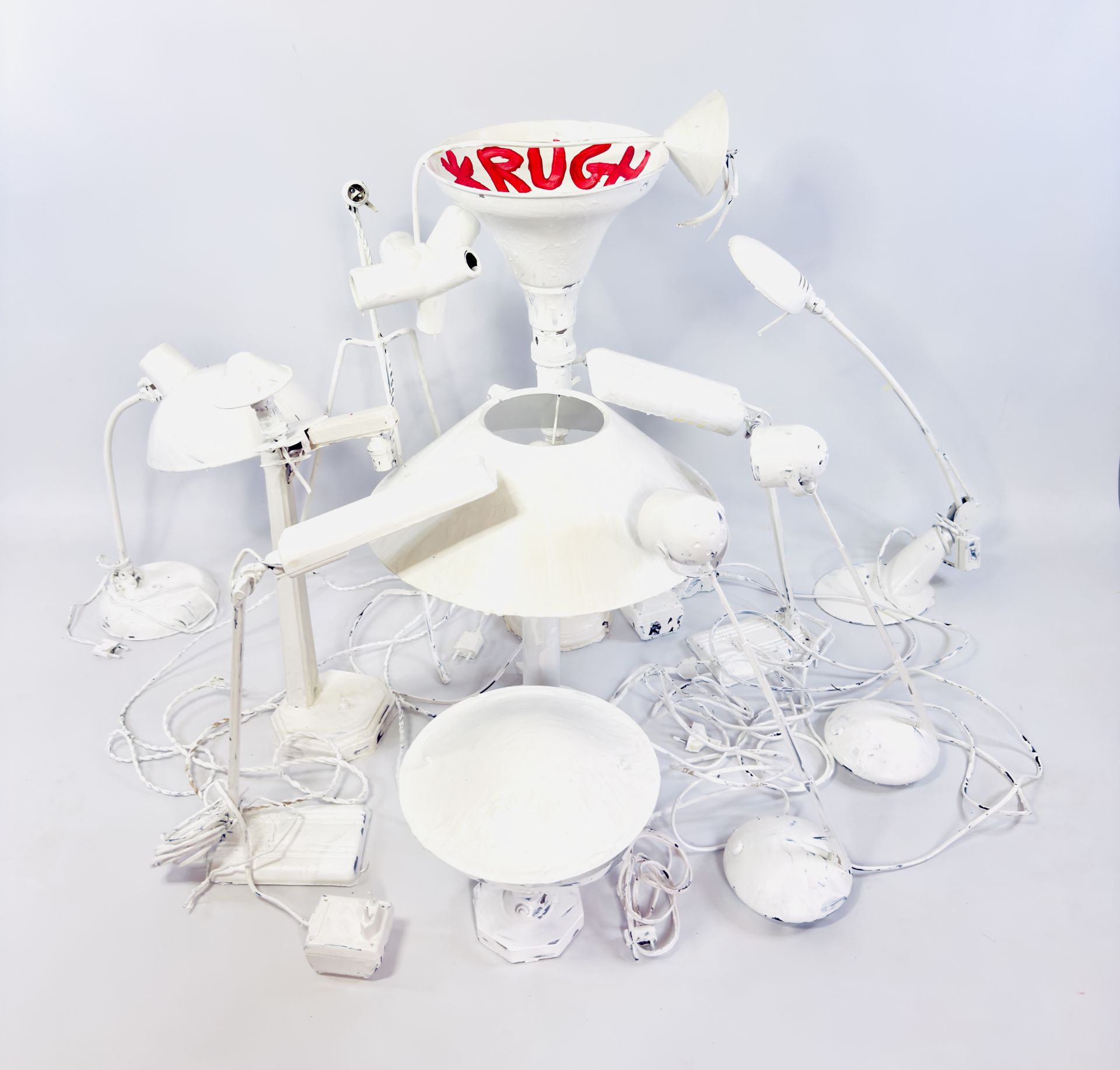
Semaphore
78x130x80
The artist gathered lamps — once fascinated by their design. He has frozen them under a single white skin, like a veil placed over what has ceased to illuminate, a gesture of passage and transfiguration: from external light to a more internal light, born in darkness.
Then, without warning, a micro red drip settled on the white. It found a breach, became a letter — g, a fragment of its name, while its full name unfolds inside a large turned lampshade, shaped like a bowl — ready to receive and reflect the light, like a semaphore.
Then the work has turned: it no longer speaks only of what no longer illuminates, but of a breath that persists and seeks passage, even in the night.
Perhaps the work suggests that sooner or later, everyone is led to seek — and sometimes to find — a light in the very heart of their darkness.
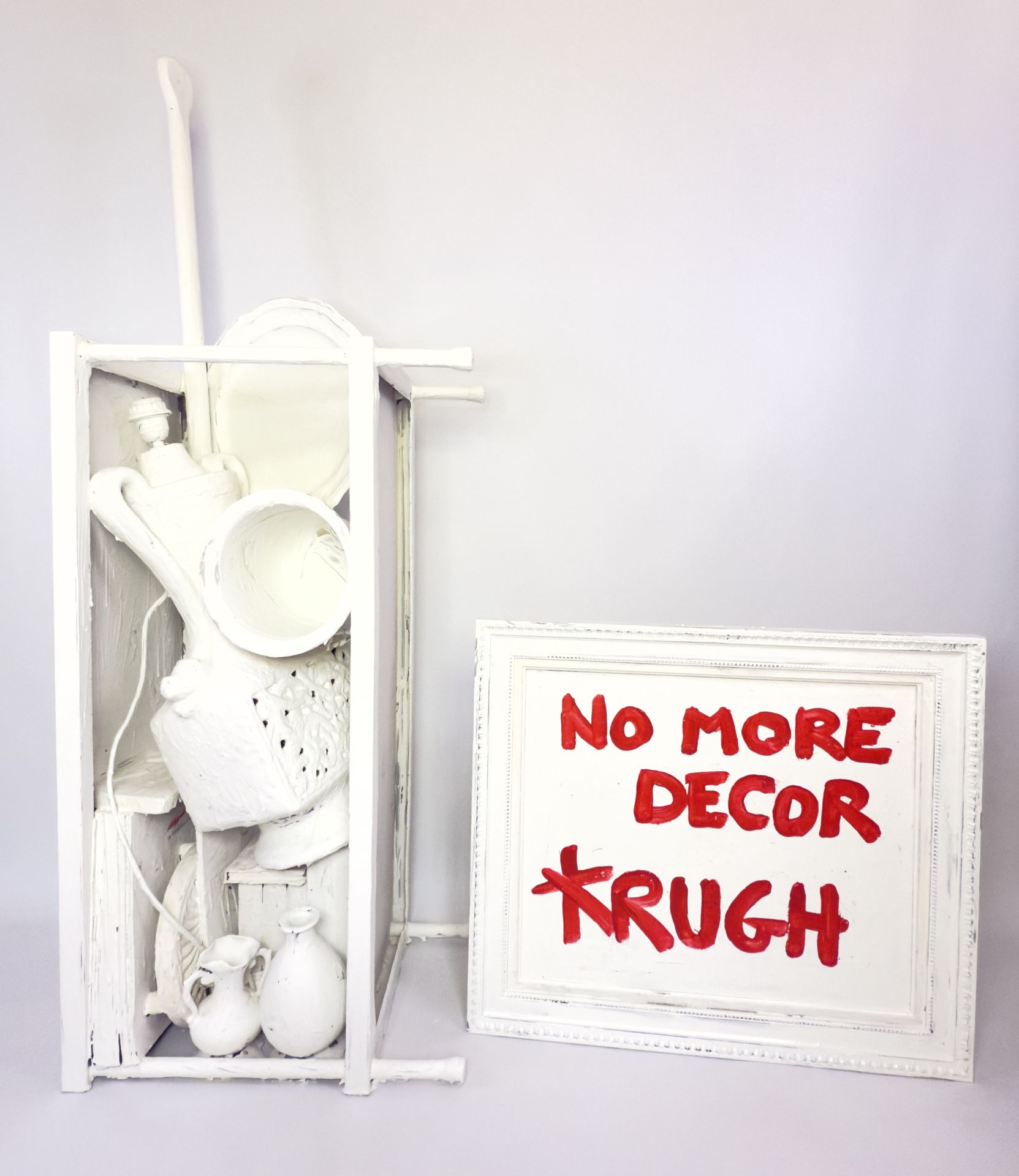
Héritage
148x120x35
Silent family objects, left in boxes, scattered here and there. Memories without a place, cumbersome. An inheritance that the artist could neither throw away nor abandon — only set aside.
So he overturned the old piece of furniture from his father's workshop. Stacked what was left. Coated everything in white by hand — a veil, a rebirth.
The decor of yesteryear fades away to transform.
Next to it, on a canvas from his childhood, he wrote in red: NO MORE DECOR. What was once a fixed decoration becomes a passage: between loss and heritage, memory and transfiguration.
This gesture also speaks of art. It breaks away from the comfort of the decorative. It calls for an embodied, living art. We all carry a heritage — material or invisible, light or heavy: stories, wounds, beliefs, values, marks left behind.
It is not about locking oneself away or erasing it, but about going through it to make it breathable, fertile.
A work like a threshold, where the past can become a present that is inhabited and meaningful.
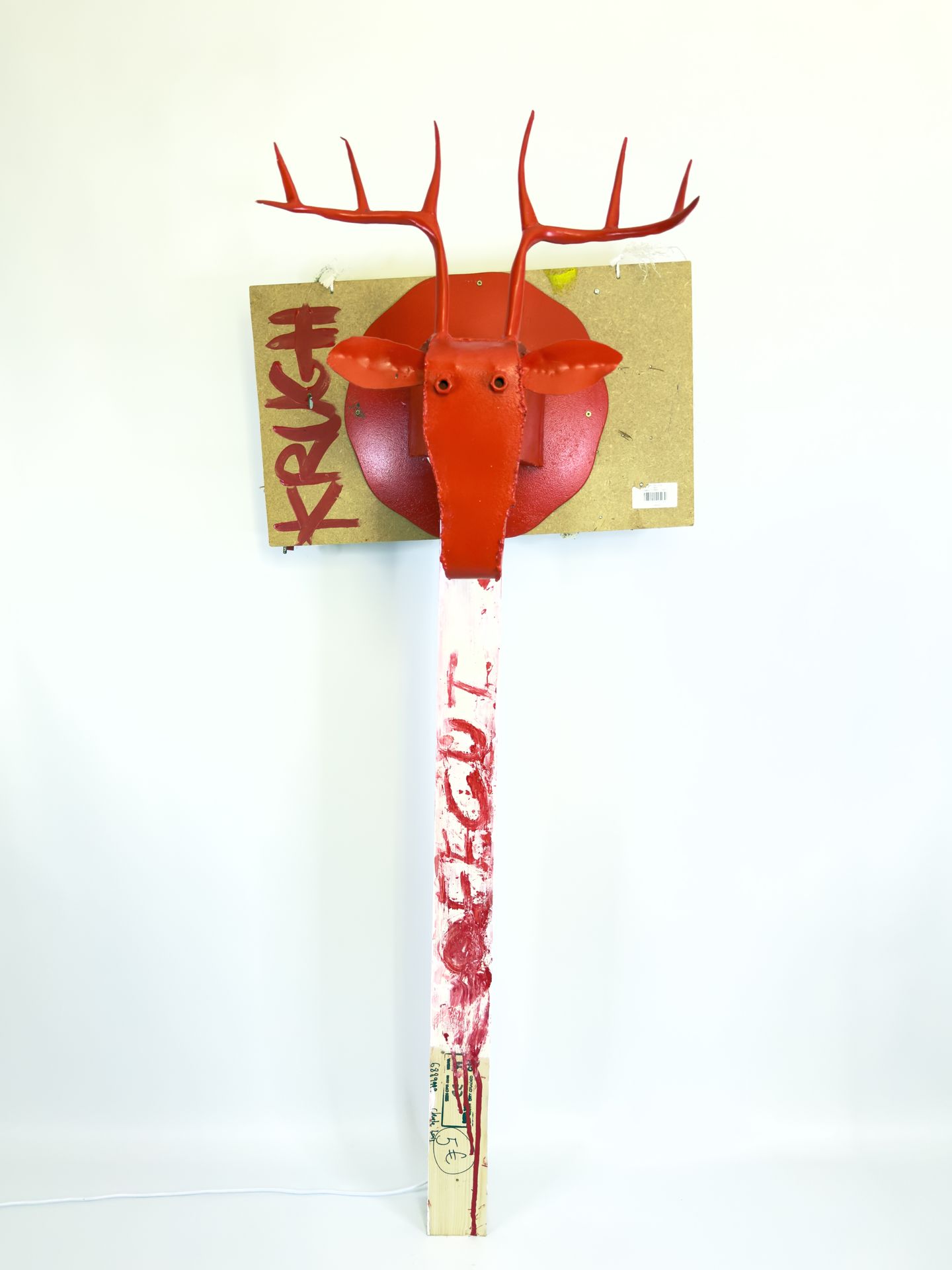
The Stag – Pillar
165x68x48
Balanced precariously on a fall of depreciated wood, stamped “5 €”, the installation stands out as unusual. The drips descend to the price, sketching a face, as if to remind us of the forgotten value of what no longer matters in the eyes of the market.
A red deer is fixed to the top. It was a workshop lamp, hanging above the table where materials and paints were piled up. Behind it, a multifunctional board, once built for his son in sensory and psychomotor learning. In one of its secret doors, a spinning disc bears the image of a young fawn.
Today, the fawn has become a stag. A great luminous stag that illuminates what, in the eyes of the world, does not fit the norm, disturbs, or is rejected.
In the panel, a lock penetrates the material, like a passage between the visible and the invisible. The paint used for signing has left, in the opening, a mark in the shape of an 8: a sign of alliance, infinity, cycle. And above, a damaged screw, reworked with a grinder, has revealed a cross on the metal. It resonates with the cross of the new cruciform screw, inscribing in the installation the repeated sign of a wounded but bearing passage.
In tradition, the stag symbolises the soul seeking the source. Here, it stands as a figure of passage and light: a sign that what seemed out of the world, excluded, devalued, becomes the pillar.

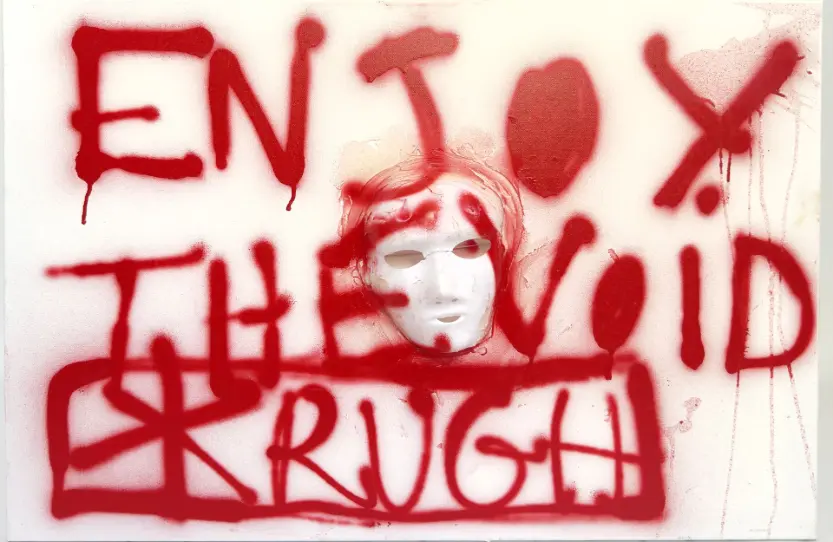
Enjoy the Void
54x81x9
A red and white sign, like an advertising poster.
A screaming slogan: ENJOY THE VOID. In the centre, a frozen white mask.
The spectator is faced with a paradoxical injunction: to enjoy the void, to consume the absence. Behind the mask lies a dehumanised, disembodied humanity, reduced to a lifeless facade.
Under the irony of the slogan, it is a denunciation: the contemporary world where the mask is in force, where the being fades behind appearance.
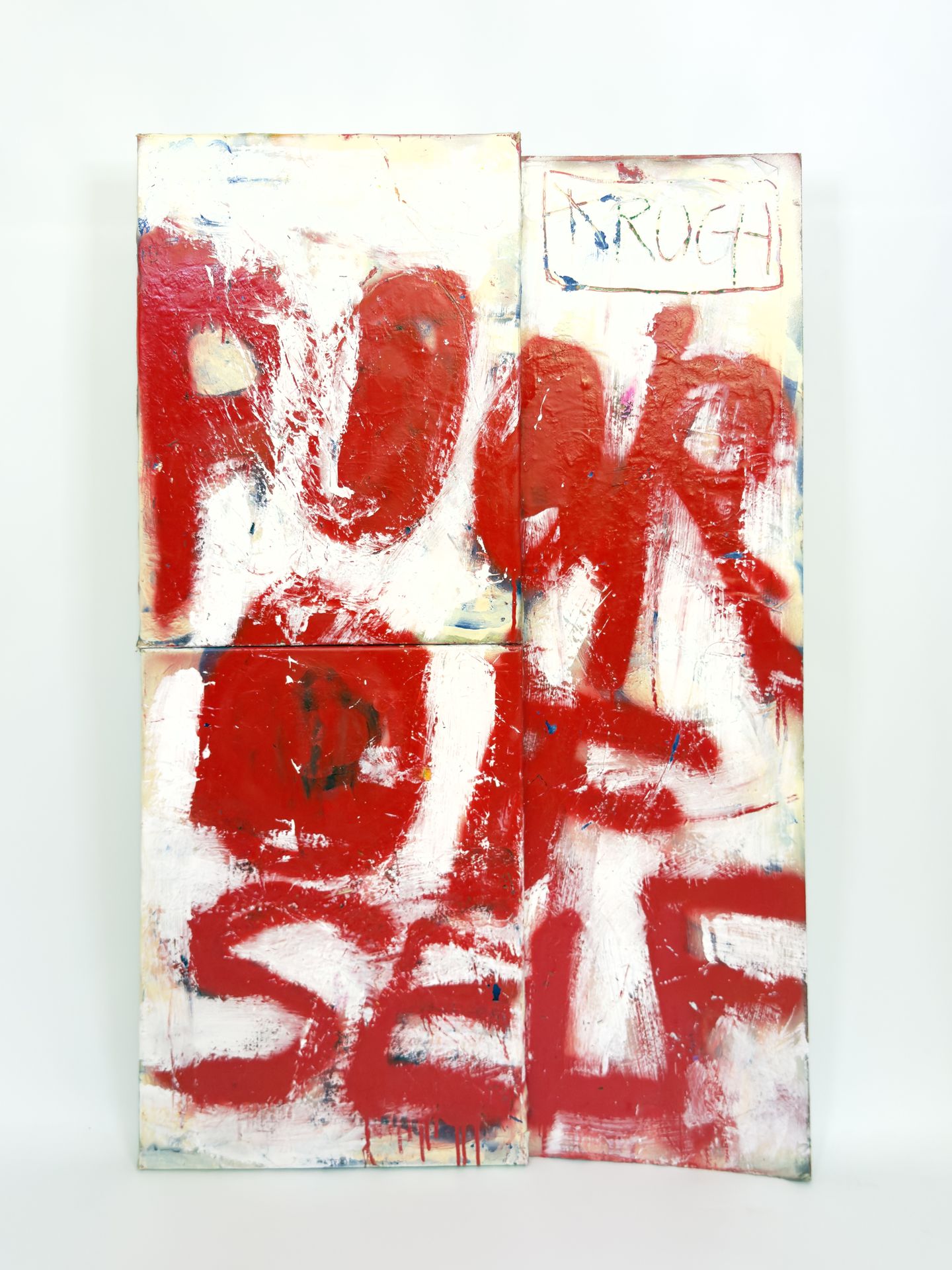
POOR OF SELF
124x80x3
Two figures have disappeared beneath the material: one standing in motion and the other kneeling. Only the erasure, the red scream, and a name scratched with a nail like a scar remain.
This work exhibits nothing but the poverty of self: to acknowledge the fall, to plunge into the abyss, to consent to no longer appear. It is a pictorial confession, a place of stripping away.
To be poor of self: to empty oneself, so that something else may come to be.
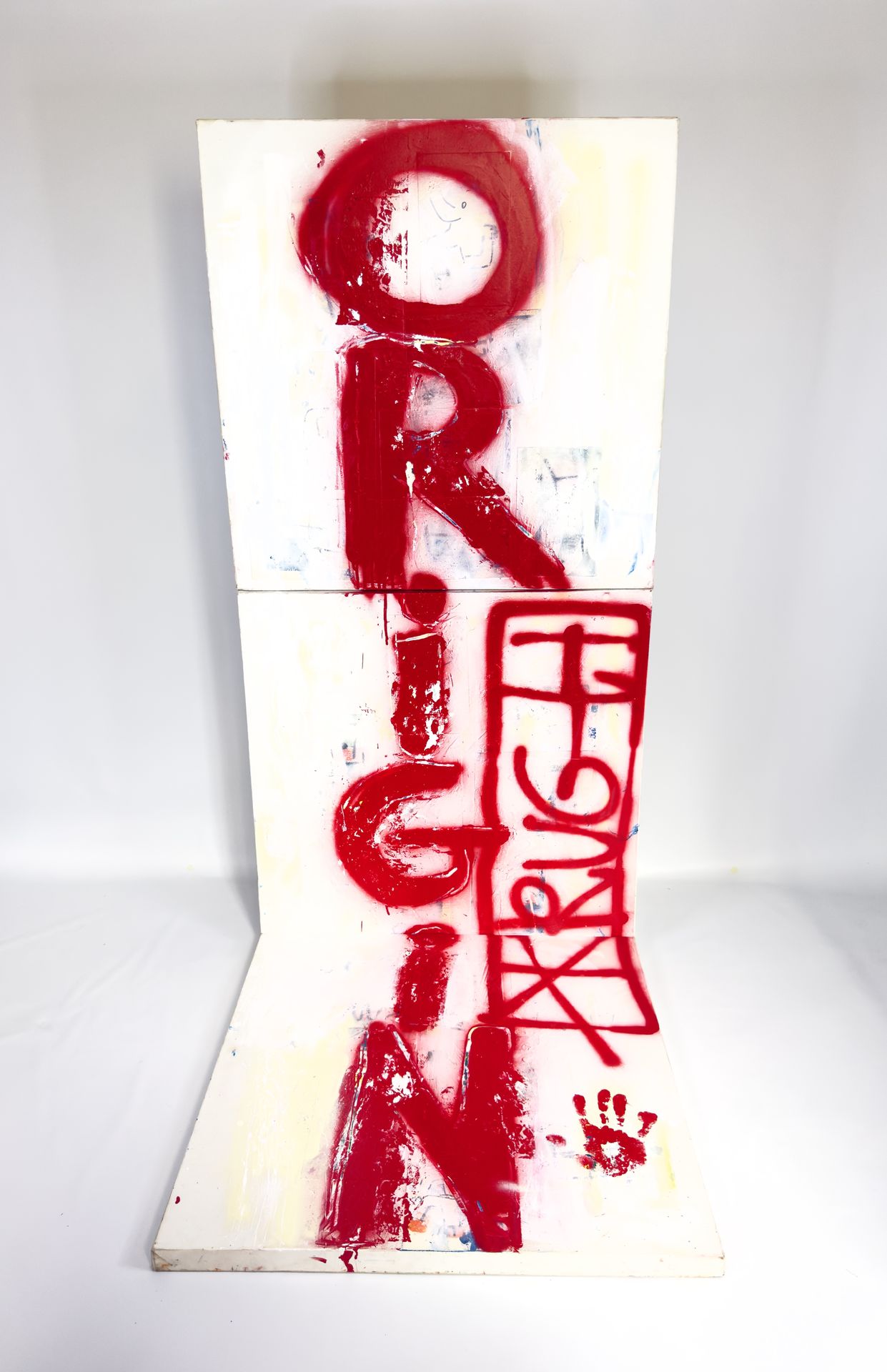
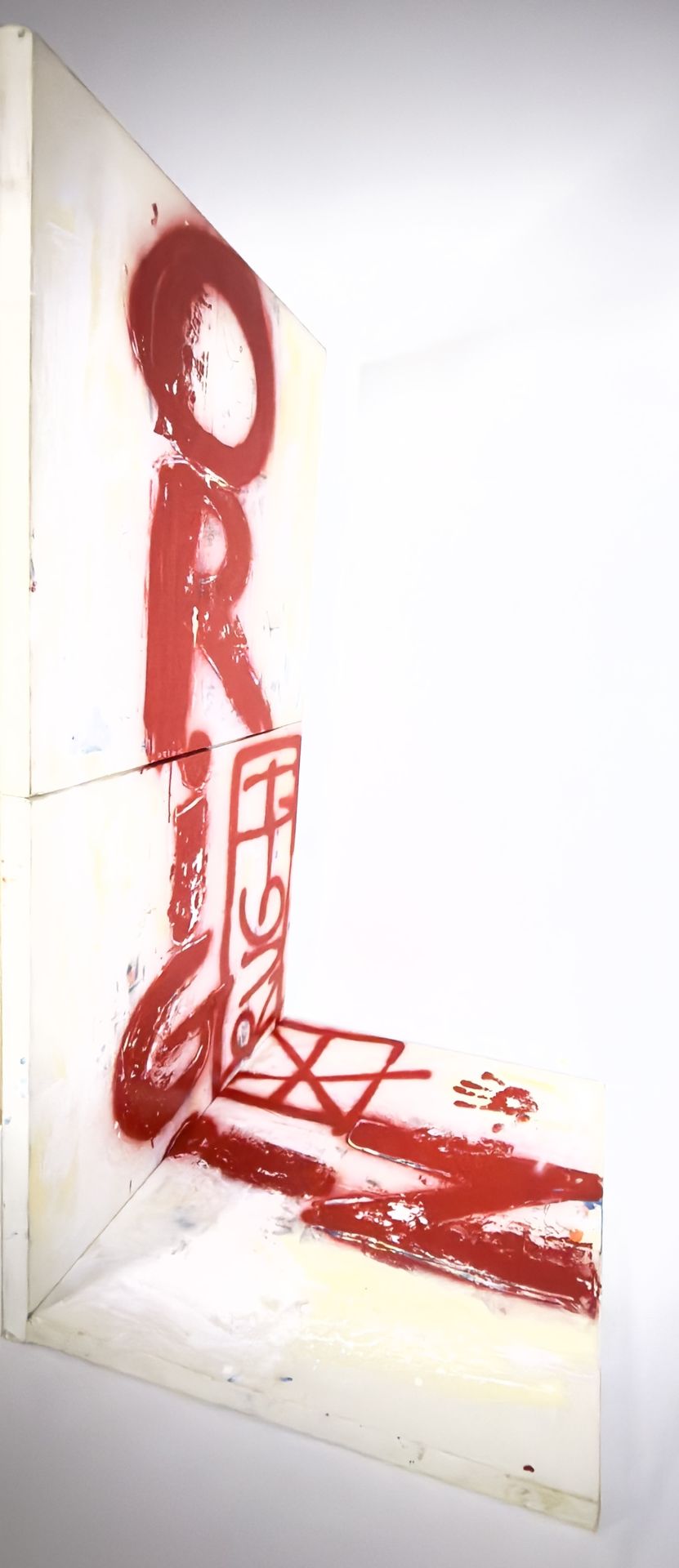
ORIGIN
142x70x90
In 2021, the artist goes through a turning point: with his eyes closed, he discovers that the gesture freed from control brings forth figures more alive than those guided by will. The triptych, born from this experience, retains the trace of this revelation: art becomes a place of truth, a quest for freedom, driven by a greater inspiration.
Then covered with the word ORIGIN inscribed in red, the whole presents itself as a cornerstone, a foundation. The imprint of the hand sealed in the material marks the artist's commitment: to inscribe in their work the beginning of a new language, born from letting go and breath.